



Every day, millions of workers with criminal records stock our shelves, load our trucks, fix our roads, and build our cities. They’re told they’re lucky to have any job at all, but here’s what we’ve uncovered: They’re not just working, they’re being systematically exploited by low-road industries that profit from their records.
Today, we’re proud to release The Temp Trap: A Blueprint for Organizing Workers with Records in the Temp Industry, a landmark report exposing how the temp industry works and laying out a strategy to organize workers with records to win dignified work.
This report is the result of two years of field work and research, including:
1,443 doors knocked
608 conversations with impacted community members
183 surveys conducted inside Miami-Dade jails
83 temp agencies and 58 reentry and workforce organizations across South Florida surveyed
The Temp Trap: A Blueprint for Organizing Workers with Records in the Temp Industry
Foreword by Maya Ragsdale & Katherine Passley, Co-Executive Directors, Beyond the Bars
The predominant narrative about people reentering society after incarceration is that they are excluded from the job market—that they can’t find work. But as our report will expose, the truth is more insidious. People with records are working, often in the lowest paid, most dangerous jobs in our country, precisely because they have records. They’re locked out of good jobs and left to survive in the most unstable, exploitative ones.
Our work at Beyond the Bars begins with a simple truth: There is no path to ending incarceration without transforming the conditions of work.
The United States has built an economy where punishment and labor exploitation are deeply intertwined. Inside our nation’s prisons, multimillion-dollar compounds are sustained by the coerced labor of incarcerated people, who cook meals, clean cells, cut grass, repair roofs, and perform nearly every task needed to keep facilities running.
They are, however, excluded from all federal employment protections, denied the right to organize, and stripped of the wage, health and safety, and anti-discrimination standards that apply to nearly every other workplace in the country. As a result, they are often paid pennies—or, in many cases, nothing at all—for their labor, and are routinely assigned to dangerous jobs without health and safety training or recourse when they are injured.
The experience of performing labor under coercion leaves a lasting mark. Inside prison walls, incarcerated people learn that work means control without rights. Upon release, they enter a labor market that is hauntingly familiar, with the authority of the prison guard replaced by that of the supervisor, and the control of the cell replicated on the shop floors of low-wage, high-turnover jobs. What is often dismissed in popular and policy discourse as a “prison mentality” is, in truth, a rational adaptation to a labor market that cheapens labor, normalizes disposability, and trains people to accept exploitation as inevitable.
Many of the same jobs people perform under coercion in prison—cooking, cleaning, repairing, building, caring for others, and resolving conflicts—exist outside as stable, higher-wage careers in culinary arts, sanitation, logistics, construction, care work, and conflict mediation. People returning home from incarceration already possess the skills to thrive in these fields, yet the doors remain largely closed to them. Background checks, licensing restrictions, liability policies, insurance barriers, and employer stigma block access, creating a cruel paradox: The state profits from people’s labor inside only to bar them from the very industries their work sustains once they’re free.
Locked out of stable careers, people returning home are funneled into the only jobs still willing to take them. The temp industry has become the default entry point after incarceration. A person might apply for a warehouse job paying $25 an hour, get denied because of a background check, walk next door to a temp agency, and then be sent to that same warehouse the next day, doing the same work for minimum wage while the temp agency captures the difference.
Temp agencies promise what other employers won’t: fast placement with no background checks, a ride, a badge, and quick pay. When bills and court fees pile up, they are one of the few avenues that open quickly enough.
This report exposes how the carceral and temp labor systems together create a workforce that can be easily controlled, underpaid, and silenced. It also lays out a roadmap for change rooted in our forthcoming strategy document, “The Economic Freedom Agenda,” which advances two interconnected objectives: raising standards in the temp industry and expanding access to union jobs, through which workers can obtain stability, fair wages, and collective power.
We offer this report as a blueprint for organizers across both the decarceral and labor movements. It is a tool for decarceral organizers to critically examine how we approach “reentry,” to recognize our shared interests with labor, and to understand that without engaging workers’ economic conditions head on, we cannot win. And for labor organizers, it is a call to see the realities, resilience, and profound skills of workers with records—and to understand that organizing these more than 114 million workers is not optional or peripheral, but essential to the survival and future of the labor movement itself.
Temp work is reshaping entire industries and threatening to set the floor of wages, rights, and conditions for all workers. If we don’t organize workers within temp agencies, we cede the ground on which the future of work will be built.
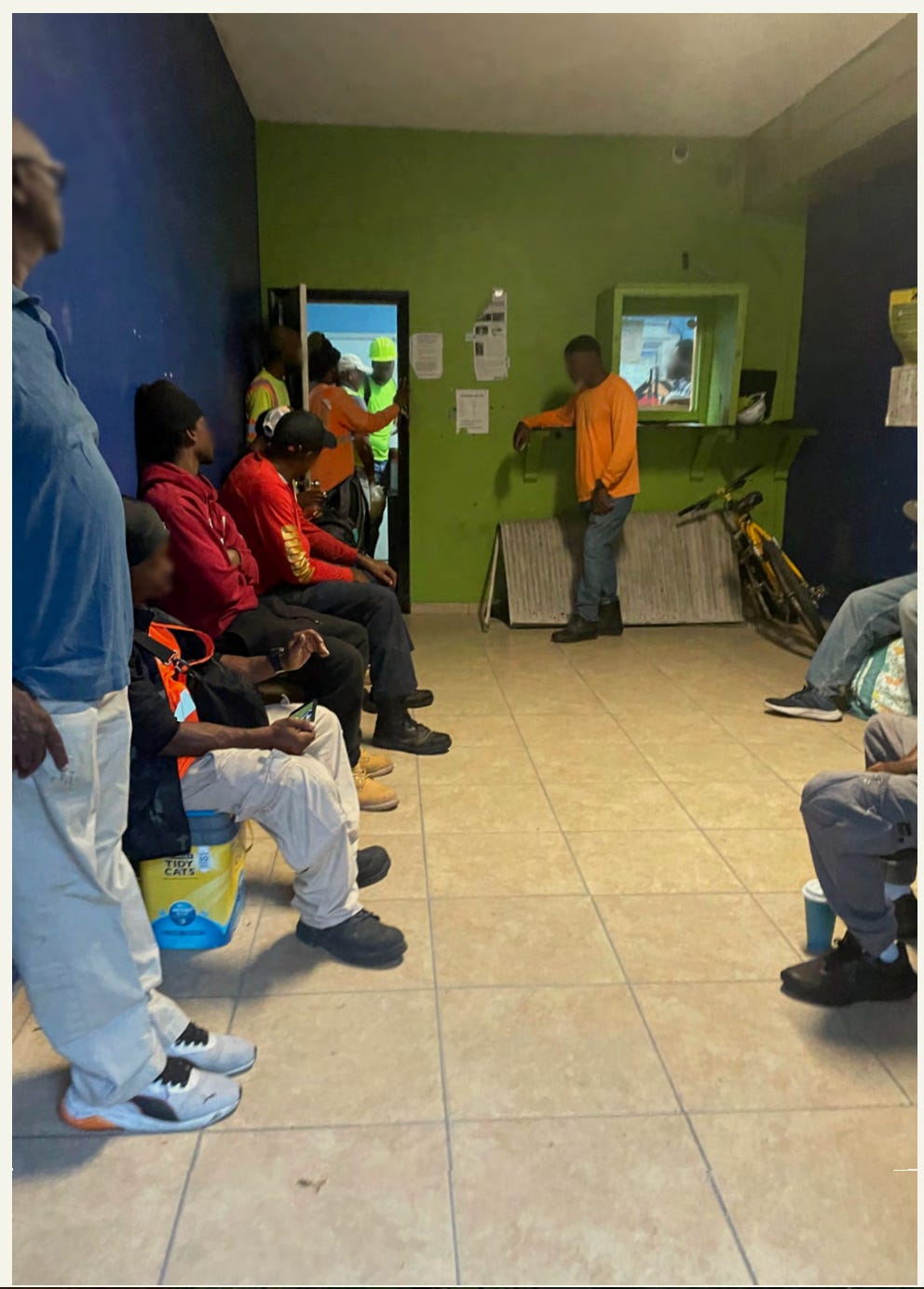
Labor pool in North Miami. (Note: faces blurred for privacy.)
FROM MANAGER TO CONSTRUCTION LABORER
As our report uncovers, many people returning from incarceration bring valuable skills and prior work experience from a wide range of occupations, yet those skills are often ignored or underutilized by the industrial temp agencies that funnel them into low-wage, manual labor.
Felix, a Beyond the Bars member, shared, “Before I went to jail, I was a manager at Office Depot. When I came out, I couldn’t get the kind of jobs I had before. Probation required a paycheck, and I had court fees due. With better jobs closed off because of my record, I ended up at a temp and labor pool—doing construction, which I’d never done before.”
Temp agencies aren’t a choice; they’re practically the only option. Even before a person leaves prison or jail, they are often handed a list of temp agencies to contact upon release. Felix recalled receiving a packet of information that included the names of several temp agencies before he was even released. On its face, giving someone a head start on finding employment seems like a good thing, but it wasn’t that simple. “When I got out, my first thought was, I’m going to use what they gave me,” he said. “That’s the first place you go, but when you get there, they’re not really helping anybody.”
Felix’s story isn’t an anomaly; it’s the system working exactly as designed. Our report shows how we raise the floor for all blue-collar temp workers.
SINCE THE LAST WORK RELEASE
Highlights from our month of organizing, advocacy, education, and support this month.
Worker Organizing. We held our monthly Worker Organizing Committee meeting, where worker-leaders took key roles in facilitating the meeting. Attendees reported back on their commitments, including site assessments at temp agencies, canvassing, and mobilizing to Tallahassee, and discussed next steps for organizing temp workers toward dignified work.
Worker Advocacy. We mobilized to Tallahassee from October 9–16 during legislators’ second committee week, meeting with lawmakers and sharing the realities temp workers face across Florida. We’re building on last session’s success, when our members helped stop harmful rollbacks that would have harmed nearly one million blue-collar temp workers, by continuing to push for stronger protections and a fairer labor market for our communities.
Worker Education. Our member, Xavier, held our monthly book club, attended by nine other members. This month’s reading was an excerpt from Haiti: Trapped in the Outer Periphery by Robert Fatton Jr., discussing how Haiti’s ongoing political and economic crises drive migration to the U.S. and shape the experiences of Haitian workers in Miami. Another six members participated in our political education on the labor market and economics during our Walk-in-Wednesday at our office.
Worker Support. Through our participatory defense work, we welcomed three members home: Jason returned after 10 years of incarceration, and Racheeve and Jermaine came home after beating a probation violation. We helped Matt avoid jail time by challenging his alleged probation violation with the support of ROOT Legal. We also secured travel motions for three members on probation to join our upcoming Tallahassee mobilization for our FLPA advocacy. Finally, we held a restorative justice circle to quash interpersonal beef between two members that spilled over into their work at temp agencies and their organizing commitments with us.
Cross-Movement Solidarity.
We formalized a partnership with UNITE HERE! Local 355’s Hospitality Education & Training Program to provide space for hospitality training classes at our Miami headquarters. This collaboration deepens our work building pipelines into union apprenticeships and training programs for people with records.
Our team had a big presence at COSHCON 2025. Freddy won the Worker Power Organizing award presented by National COSH for his contributions to worker health, safety, and justice. Kat spoke on COSHCON’s main stage on a panel, Voices Across Platforms: Storytelling and Organizing, alongside organizers from Organized Power in Numbers (OPIN), New Labor, and the Union of Southern Service Workers (USSW). Meanwhile, our organizers co-facilitated a workshop called Justice on the Job: Organizing Across Incarceration and Temporary Work, teaching participants the fundamentals of temp worker organizing through hands-on roleplay.
We hosted and co-facilitated the Temp Worker Advocacy Coalition (TWAC) convening at our Miami office, bringing together organizations from across the country that are organizing and advocating for blue-collar temp workers in sectors like green energy, warehousing, stadiums, hospitality, and construction.
Team Development.
Maya was selected to join Aspen Institute’s Job Quality Fellows, Class of 2025-2026 and recently kicked off the fellowship in Birmingham, alongside leaders from organizations like USSW and the Lift Fund. This fellowship brings together leaders who are working to expand the availability of quality jobs across the South.
Kat returned from Return & Reclaim with Mass Liberation in Accra, Ghana, reconnecting with her ancestral culture in West Africa and deepening her somatics practice. She also graduated from the Quilombo School for Exemplary Movement Leadership Director & Lead Organizer’s course through BOLD (Black Organizing for Leadership and Dignity).
Jean attended Legal Defense Fund’s conference in New Orleans, On the Rise: Securing the Future of Organizing, connecting with lawyers and organizers building power as authoritarianism advances.
COMING UP
TALLAHASSEE MEMBER MOBILIZATION
NOVEMBER 17-21, 2025
We’re mobilizing to Tallahassee from November 17–21 to meet with legislators and advocate for stronger protections for workers with criminal records across Florida.
Members, contact your organizer to join.
ORGANIZING 4 POWER (O4P) TRAINING
NOVEMBER 18 & 20, DECEMBER 2 & 4, 2025
O4P, a global training program teaching the core fundamentals of organizing founded by Jane McAlevey, is starting up. We’ll be participating with Beyond the Bars member-leaders, and will host a book club on No Shortcuts: Organizing for Power in the New Gilded Age to solidify and discuss what we’re learning.
Members, contact your organizer to join.
GIVE MIAMI DAY
NOVEMBER 20, 2025
Give Miami Day, an online fundraising event for over 1,000 nonprofits in Greater Miami, is coming up. Beyond the Bars has a goal of raising $12,000. Early giving starts on November 15th and Give Miami Day is on November 20th.
Click HERE to donate.
MOBILIZATION TO DC FOR ABOLITION AMENDMENT BILL LAUNCH
DECEMBER 5, 2025
On December 5th, Congresswoman Celeste Maloy (R-Utah) will introduce a constitutional amendment to end the 13th Amendment’s slavery exception, the clause that still allows involuntary servitude as punishment for a crime. Since 1865, the 13th Amendment has prohibited slavery and involuntary servitude for most people, but not for those convicted of crimes. This exception continues to enable coerced labor in prisons today. As a member of End the Exception’s Steering Committee, Beyond the Bars will be in D.C. helping with the bill introduction. There will be a press conference, legislative visits, and organizing for the fight ahead.
Members, contact your organizer to join.
FIFTH ANNIVERSARY CELEBRATION: CAGED BIRD ARTS SLAM
DECEMBER 14, 2025, 7:00PM
Join us for the Caged Bird Arts Slam, a night of celebration and resistance in honor of Beyond the Bars’ fifth anniversary. We welcome poets, musicians, and visual artists to share their work on the theme of reclaiming economic freedom.

To share your art, email your name, phone number, and art medium to info@beyondthebars.org.
To attend, RSVP at bit.ly/BTBCagedBirdArts.
MEMBER SHOUTOUT
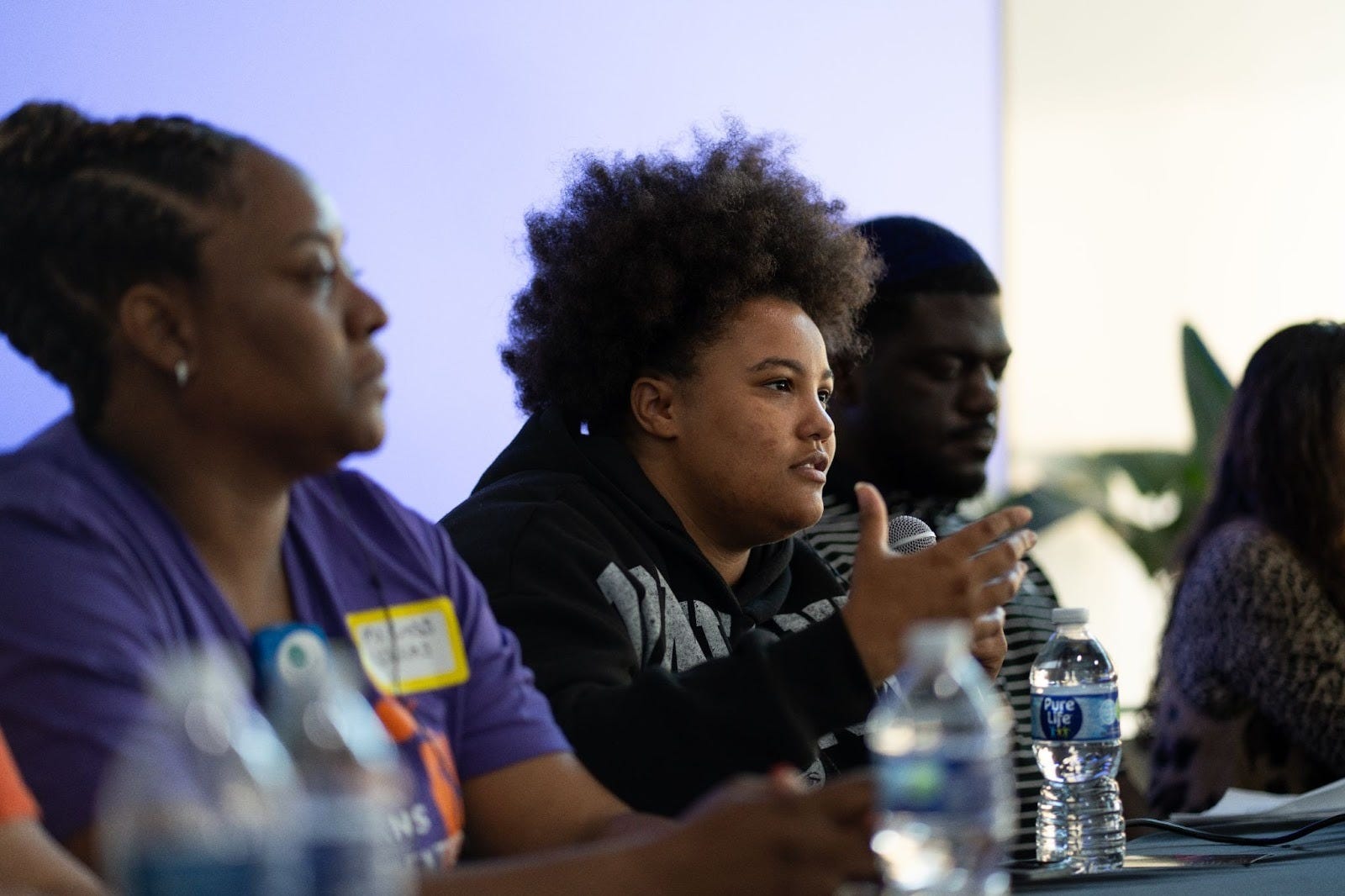
Cece speaking about her experience as a temp worker during a panel at the TWAC convening.
This month, we’re celebrating member-leader Cece, who brought six new temp workers into our organization this month, four of whom signed membership cards and took on new commitments, such as facilitating our monthly member meeting, mobilizing to Tallahassee, and conducting site assessments at temp agencies. All completed an in-office training and joined a political education session.
Cece also spoke on a worker panel at the TWAC convening earlier this month, and supported Caged Bird Arts’ upcoming Slam, writing letters to friends and others in Florida jails and prisons to invite them to share their artwork for the event.
WHAT WE’RE READING
A Strategy to Stop the Flow of Our Money to Billionaires by Sara Myklebust & Saqib Bhatti
The trillions of dollars in our retirement savings are enriching the ultra wealthy while they ravage our communities. A mass movement led by workers and pensioners can turn off the tap.
Below the Floor: Court-Ordered Community Service Lacks Labor Standards by Han Lu & Noah Zatz
This is part two of a series that uncovers coerced labor in community service programs operated via the criminal legal system, a widely recognized engine of anti-Black structural racism and economic inequality.
We Can Use Predistribution to Fight Income Inequality by Matthew Dimick
Mainstream economics argues that the tax system is the best tool for reducing economic inequality. In fact, “predistributive” measures like minimum wages and collective bargaining can be equally or more effective.
WE’RE HIRING
We’re hiring a Union Coordinator to anchor and expand our partnerships with labor unions across Florida and the South. The Union Coordinator will work at the national, regional, and local levels to recruit and train member teams, partner with unions, develop bargaining strategies that protect workers with records, represent Beyond the Bars in local and national labor coalitions, and more. Read the full job description. To apply, email your resume and cover letter to jobs@beyondthebars.org.
TAKE ACTION
Share the report → bit.ly/TheTempTrap
Stay Updated → @beyondbars_mia
Learn More → beyondthebars.org
Take Action → Sign up to volunteer
Fuel the Work → Donate now
I enjoyed this and would like to get more involved.