


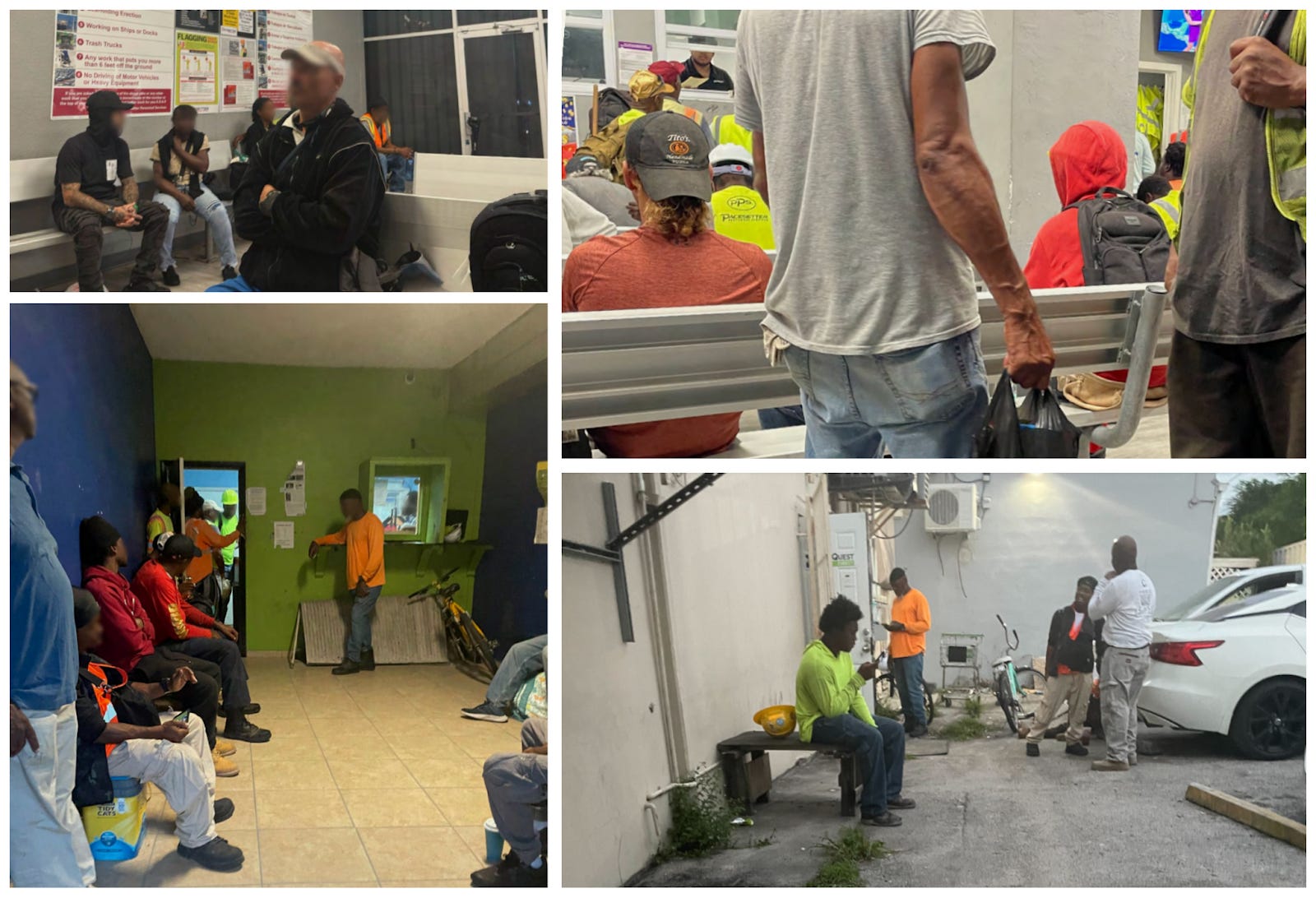
Last month, we released The Temp Trap: A Blueprint for Organizing Workers with Records in the Temp Industry, a landmark report exposing how the temp industry works and laying out a strategy to organize workers with records to win dignified work. This month, we’re diving deeper into Parts II and IV of the report: the inner workings of the temp industry itself and how to build power within it.
Inside the Temp Industry
Adapted from Part II of The Temp Trap by Maya Ragsdale and Katherine Passley
The term “temp industry” refers to a network of corporations that recruit, hire, and supply workers to host employers for short- or long-term job assignments. Temp agencies serve as the “employer of record,” managing payroll, insurance, and other administrative functions in exchange for a fee paid by host employers, which control workers’ day-to-day labor. Host employers often rely on this arrangement to distance themselves from hiring decisions, shift legal liability, avoid unionization, and drive labor costs as low as possible.
Temp agencies generate revenue by charging host employers a markup on a worker’s hourly wage, typically ranging from 20 to 50 percent for blue-collar jobs. For example, a host employer may pay a temp agency $21 per hour for a worker’s labor, while the agency pays the worker $14 per hour, retaining the remaining $7 to cover overhead and profit. In practice, this fee is borne by workers themselves and reflected in lower wages, fewer benefits, and the so-called “labor savings” temp agencies promise to employers.
This system did not emerge by accident. The temp industry was deliberately structured in the mid-twentieth century to institutionalize labor “flexibility” for employers by sidestepping unions, benefits, and long-term commitments to marginalized workers. Precarity is built into its design. Workers can be let go at a moment’s notice, moved between worksites, shifted across industries, and left suspended in the gray zone between their official employer, the temp agency, and the company that directs their daily labor, the host employer.
These fragmented employment relationships make it difficult to know where to ground organizing and enforcement strategies. The labor movement has long taught us to focus on where money and power ultimately lie, with the large client companies that set the terms for the contractors and suppliers they hire. This remains sound wisdom, especially since most temp agencies lack the name recognition and financial leverage of their clients.
At the same time, ignoring the inner mechanics of the temp industry itself would be a mistake. Understanding how the industry actually functions reveals additional leverage points that can be used to strengthen worker power and disrupt a model built on precarity.
With that said, here’s how the industry really works.
Make Temp Workers Report to Two Bosses . . .
In a traditional employment relationship, the employer of record both directs the work and benefits from it. This includes deciding how the work is done, reaping the profits it produces, and investing in the tools or infrastructure needed to sustain it. Temp agencies, however, claim the legal status of employer while exercising little control over the conditions, methods, or outcomes of the work itself.
This arrangement allows host employers to avoid responsibility under labor and employment laws by asserting that the temp agency, not the client, is the legal employer.
These blurred lines are a deliberate feature of the temp industry, not a bug. The three-way employment relationship between the temp worker, the temp agency, and the host employer enables abusive practices that allow both employers to drive down labor standards, evade accountability, and exert near-total control over workers. This is especially true for workers with records who are highly dependent on temp agencies for employment.
This arrangement functionally leaves workers reporting to two different bosses, creating confusion, stripping away rights, and opening the door to abuse. If a worker is injured on the job, who is responsible, the host employer that controls the workplace or the temp agency listed as the employer of record for workers’ compensation purposes? And if a worker is not paid for all the hours they worked, who is liable for wage theft, the agency that processed payroll or the host employer that directly benefited from their labor?
. . . Then Exploit That Confusion
Temp agencies and host employers routinely exploit this triangular employment structure to maximize profit while shielding themselves from responsibility. The industry faces little oversight, having successfully lobbied to exempt itself from most state regulations. While governed by federal statutes like the Fair Labor Standards Act (FLSA), many agencies deliberately operate with minimal assets, leaving workers unable to collect damages even when they win in court.
In practice, this lack of accountability allows modern temp agencies to function much like nineteenth-century labor brokers who funneled immigrants into dangerous, exploitative work.
Workers’ compensation and unemployment insurance systems are especially vulnerable to abuse because they have not evolved to address widespread temp work. Both systems rely on experience-rating models, meaning higher injury or layoff rates lead to higher premiums. But in temp work, responsibility follows the employer of record, the temp agency, even though injuries occur under the host employer’s supervision.
This loophole allows host employers to benefit financially without improving safety. Injuries to temp workers can effectively disappear from their record for insurance purposes. At the same time, because temp agencies are penalized for injuries that occur under host employers’ supervision, they have an incentive to discourage workers from filing workers’ compensation claims in order to keep their insurance premiums low.
The experience of Andrea, a Beyond the Bars member, reflects this dynamic.
Andrea aspired to become a medical assistant and earned a certification in the field. She was hired at a private clinic but fired after a background check revealed her criminal history. Eventually, she found work through a temp agency at a medical lab.
One day, while processing a urine sample in an autoclave, the machine malfunctioned and splattered her face with fluid. She later learned the patient had herpes.
“When I reported this through the temp agency, they told me… I have to report it through [the host employer],” she said. “When I told [the host employer], they said… I’m not an employee of theirs, I’m an employee of the temp agency. We were going back and forth, and I ended up paying for [my doctors’ visits] myself.”
In short, host employers are rewarded for outsourcing danger, while temp agencies are rewarded for suppressing claims. The result is predictable. In Florida, temp workers are 50 percent more likely to be injured than permanent employees. A 2010 study in the American Journal of Industrial Medicine found that injured temp workers also lost more work time on average.
Erect Obstacles to Permanent Work
At the center of the temp industry is one of its most persistent myths, that temp work is a pathway to permanent employment. For workers trying to rebuild their lives, this promise can be seductive.
But temp agencies have a financial incentive to keep workers temporary. As the American Staffing Association noted in 2022, “Employees are a staffing agency’s most important asset.”
To lock workers in, agencies charge host employers a placement or conversion fee before allowing a temp to be hired directly. These fees typically range from 20 to 50 percent of a worker’s first-year salary. For a worker earning $15 an hour, a 20 percent fee can exceed $6,000, often discouraging permanent offers.
Michael, a Beyond the Bars member, experienced this firsthand. A host employer wanted to hire him, offering better pay and hours, but the temp agency’s placement fee killed the deal.
“Y’all don’t own me. I work for ya’ll, but y’all don’t own me,” Michael reflected later. “So why can’t I go to a better company to better myself?”
Taken together, these practices create an industry designed to keep workers temporary and replaceable. What appears to be a bridge to opportunity is instead a revolving door. Understanding this structure is the first step toward reshaping it in workers’ interests.
Understanding how the temp industry works is only the first step. Building the power to transform it is the next.
Building Pathways to Stable, Dignified Employment
Adapted from Part IV of The Temp Trap by Maya Ragsdale and Katherine Passley
Because temp agencies are often the only option for people with records reentering the workforce, building real pathways to stable employment is essential. Partnering with unions is the most powerful way to do this. Unions are the only large, dues-funded membership infrastructure in the U.S. with both the mandate and the capacity to improve job quality at scale.
Here are a few strategies unions can use:
Organize temp workers. Unions can form temp committees, invite temps to meetings, monitor shop-floor treatment, and petition the NLRB to accrete temps in bargaining units. Temp workers at a New Bedford tire recycling plant unionized and are now represented by UFCW Local 328.
Build pre-apprenticeship and apprenticeship programs tailored to workers with records. LIUNA Local 79 in NYC and UNITE HERE in New Orleans run pre-apprenticeship programs that recruit workers with records into the building trades and hospitality.
Create union worker co-ops and hiring halls for workers with records. UFCW Local 328 supported Rhode Island’s first worker-owned cannabis co-op, employing people harmed by the War on Drugs.
Bargain for pathways into union jobs. SEIU Local 26 pushed Target to adopt “ban the box” nationwide. Other locals won contract language protecting members from termination due to incarceration. Others still require employer accommodation for immigration hearings, adaptable to workers dealing with criminal court mandates.
Collect demographic information to tailor member benefits. Many unions already represent members with records and can tailor benefits to their needs, such as providing expungement or probation-termination support. United Steelworkers (USW) has been helping folks clear their records in Chester, South Carolina.
This work can be replicated and expanded across the country. With 114 million people, approximately one-third of the U.S. workforce, carrying criminal records, the opportunity is enormous. By integrating workers with records into organizing, recruitment, and retention strategies, unions can build power for millions while raising standards across industries that have long used criminal records to suppress wages.
As we build power with temp workers across Florida, we’re uplifting one member each month whose leadership embodies why this work matters.
Member Shoutout

Click the above video to listen to Ronald speak about his experience coming home after 25 years of incarceration and why he’s organizing with Beyond the Bars now.
This month, we’re celebrating Ronald Clayton, whose commitment to building worker power has been unstoppable. Ronald recently completed our organizing training on how to have effective organizing conversations through 1:1s and has been diving deep into No Shortcuts: Organizing for Power in the New Gilded Age, traveling all the way from Homestead to our office in Miami to discuss what he’s learning and how to apply it in the field.
Ronald also stepped up to conduct a site assessment and committed to mobilize to Tallahassee. Although parole restrictions prevented him from joining the trip, his dedication to the work and his growth as a leader in our organization set an example for all of us.
Ronald’s growth reflects the momentum we’re seeing across our base. Here’s what our members and staff have been building since the last Work Release.
Since the Last Work Release
Worker Organizing. We closed out the year with our final Worker Organizing Committee meeting, where members continued stepping into leadership roles. Worker-leaders shared updates from our Tallahassee mobilization, presented findings from The Temp Trap, and reported back on the commitments they set at the previous meeting. This month, 9 of the 11 members who committed to salting followed through. They worked at warehouses across Miami-Dade and Broward to do field research and build relationships with new workers on the job. We also wrapped up the Organizing 4 Power (O4P) Training with members, completing modules on key organizing language, foundational concepts, and organizing math. And our community came together for Caged Bird Arts, celebrating resistance, creativity, and five years of building worker power.
Worker Advocacy. Six Beyond the Bars members traveled to Tallahassee to meet with state legislators and share their experiences navigating Florida’s job market with a criminal record. Over three days, they met with 17 lawmakers from both parties, deepening relationships that will shape our 2026 legislative strategy.
Worker Education. We closed out the year with our final Cabral Club reading group, where members examined the economic history of Venezuela and what it teaches us about working-class power in the U.S. We discussed how decades of policies favoring the wealthy, including high-interest lending, inflation, and the dismantling of social protections, hollowed out the Venezuelan working class, broke faith in the traditional two-party system, and paved the way for a people’s movement to rise. Six members joined the conversation, drawing clear parallels to our own context in Florida and discussing what it will take to build a movement capable of shifting real power back into the hands of working people.
Worker Support. This month, members showed up for one another by providing court support for one of our members and by organizing a holiday turkey drive that provided meals to temp workers and their families throughout South Florida.
Cross-Movement Solidarity.
We’re gearing up to host UNITE HERE Local 355’s HEAT team in our office starting January 12, expanding the support and organizing infrastructure available to our members. We also stood in solidarity with the Minnesota Incarcerated Workers Organizing Committee and Central Florida Jobs With Justice in Orlando to demand that Disney take responsibility for abuses in its supply chain. Disney’s supplier, Anagram International, employs incarcerated workers, who are forced to labor for less than $1 an hour, to manufacture Disney character balloons. Disney sells these balloons for up to $45 per jumbo Mickey Mouse balloon.
Beyond the labor movement, we continued building bridges across justice sectors. Our team spoke at the University of Miami School of Law’s Human Rights Symposium on a roundtable exploring gender-based violence in South Florida, highlighting how economic isolation, produced by both employer practices and the carceral system, is one of the most pervasive but least recognized forms of violence. We also presented The Temp Trap at the Umbrella of Hope reentry coalition, sparking conversations about the role of temp agencies in shaping the economic realities facing people returning home from incarceration.
Organizational Development. This month, we continued deep research into creating a unionized staffing cooperative, an alternative to a traditional temp agency that puts control back in the hands of workers. Shout out to AlliedUP and SEIU-UHW, who’ve led the way nationally in showing what a worker-centered staffing model can look like. Their example is helping us imagine what’s possible here in the blue-collar temp industry. We also closed out the year with our weekly somatics centering practice, grounding ourselves every Wednesday in the skills and resilience needed to build a long-term movement for worker power.
With all of that behind us, here’s what’s coming up next.
Coming Up
Winter Break & Staff Retreat (Dec 15, 2025 to Jan 11, 2026)
Our office will be closed from Dec 15 to Jan 4 for our annual winter break, followed by our staff retreat from Jan 5 to 11. During this period, our team will not be checking email. We look forward to reconnecting once we’re back in action. If you have an urgent request during that time, please email maya@beyondthebars.org with “URGENT” in the subject line.
While we pause for winter break and gear up for our retreat, we’re staying connected to national conversations to inform our work. These pieces stood out this month.
What We’re Reading
The Impact of Incarcerated Labor in Hyundai’s U.S. Supply Chain by Susan Helper, Suresh Naidu, Adam Reich, and Aaron Sojourner
This groundbreaking report examines wages and working conditions in Hyundai’s Alabama supply chain. It finds that a 10% increase in the share of incarcerated workers at a plant is associated with a 10–14% decline in wages for non-incarcerated workers. Because incarcerated workers face coercive prison conditions and are far less able to quit over low pay, their presence gives employers leverage to suppress wages and degrade working conditions across the entire workforce.
Making a May Day 2028 General Strike a Reality by Alex Han
The idea of a May 2028 general strike, proposed by UAW president Shawn Fain, may sound impossible. But a strategic look back at the coordinated strikes and militancy of the past two decades shows we might be much closer than we think.
Get on the Job and Organize with Inside Organizer School by Amie Stager and Isabela Escalona
How a new generation of leaders is reviving the labor movement through salting. More on salting here.
If these ideas resonate with you, here are a few ways to take action with us.
Take Action
Share the Report → bit.ly/TheTempTrap
Stay Updated → @beyondbars_mia
Learn More → beyondthebars.org
Take Action → Sign up to volunteer
Fuel the Work → Donate now