

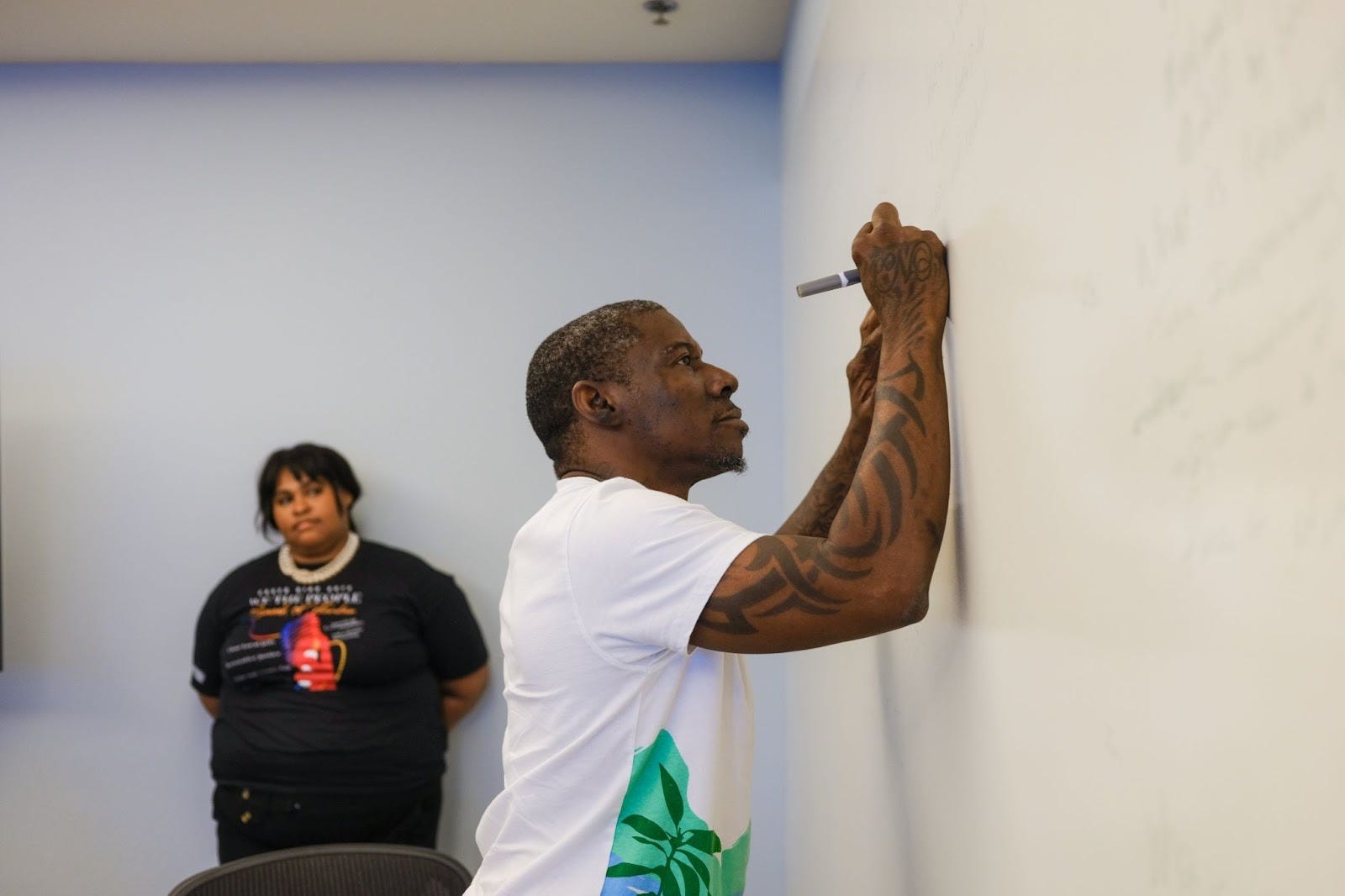
This issue of The Work Release is dedicated to the memory of our brother Akeel Nizam Williams, who recently passed. His life and leadership are a testimony of brilliance, kindness, and dedication to personal and structural transformation. The picture above was his favorite, and showed him how he always was: thoughtful, learning, and engaged.

In Memoriam: Akeel Nizam Williams
Akeel was a leader in every sense. He was a core part of the Beyond the Bars family. He joined our organization in its earliest years, helping build it from the ground up. Every single one of us quickly grew to love him and his family. He was a profoundly gentle and kind person, and also someone who took up position after position in our organization, canvassing alongside other members, leading education spaces, making signs and prepping materials at the library before actions, graduating from our Organizer-in-Training program, and showing up to facilitate workshops, wearing his BTB shirt with pride.
He explained in the video above why collective power is so important:
“No one knows your problem until you bring light to it. That’s what we’re here for. You might not be able to be heard by yourself, but if you come as a group, we prove you can get heard. We done made miraculous changes at Beyond the Bars.
It’s getting everyone to understand that your life story is extremely important. We’re taught that because we’re felons we don’t mean nothing. We’ve been bamboozled.
Once you understand your rights, it’s so hard to see people go through this stuff. Just to know I won’t go through this isn’t enough. I don’t want my kids or my neighbors to go through it. That’s what we’re here to do.
Once you start, it’s a bug; you won’t want to stop.”
Akeel was also a Rising Leader with our partner organization, the National Coalition of Occupational Safety & Health (National COSH), and a member of the Mass Liberation Project community, where he participated in the Black Intensive Groundwork (BIG) training.
Akeel inspired everyone around him. As one of our partners wrote: “He was someone who inspired so many of us through his determination, authenticity, and deep commitment to this movement. We will truly miss him as such a powerful and inspiring worker-leader.”
We hold his family and loved ones close during this time and ask our community to check in on one another.
Rest in peace, Akeel. We miss you. You will never be forgotten.
At our 5th anniversary celebration this year, a poetry slam, Akeel was honored with the Founder’s Award. In that spirit, we share this piece by two of our members, a performance about providing testimony at government hearings to support our legislative work, where so many of us, Akeel included, raised our voices together.
We Are Not Disposable
Collaboration by Alfredo (A) and Kat the Poet (K) from Beyond the Bars Published in It’s Lit: Word of Mouth, An Inaugural Chapbook.
K:
They told us
the cost of survival was silence.
That if we worked hard enough, bent low enough,
maybe
Just maybe we could buy back our dignity,
discounted,
with no warranty.
A:
No guarantee, of equal opportunity
Dumbfounded,
We lost the possibility of civility
Astounded,
Their face when they see dreads and tattoos in their waiting
rooms asking to be seen
K:
We were never supposed to make it to the Capitol.
Never supposed to raise our voices past the steel bars they
tried to build inside our throats.
They thought if they labeled us “temporary day laborers,”
we would forget we are day makers,
building cities brick by bruised brick,
tired hands touching the sky
for a wage that won’t even reach the rent.
We honor Akeel’s spirit by continuing the work he helped build. What follows is an update on where that work stands, in the Capitol, in our workplaces, and in our communities.

Clayton offers powerful testimony to members of Florida’s Commerce & Tourism Committee on January 29th.
From the Capitol: SB 1112 Passes Two Committees Unanimously
Our members showed out. SB 1112 has now passed two Senate committees unanimously, first the Commerce & Tourism Committee (9-0) on January 29, and then the Appropriations Committee on Transportation, Tourism, and Economic Development (13-0) on February 12.
At both hearings, Beyond the Bars members traveled to Tallahassee. Not a single person testified in opposition. Dozens waved in support, including the Florida AFL-CIO and the Florida Center for Fiscal and Economic Policy.
Here’s what our members told lawmakers:
Clayton Blackford spoke from the heart about how placement fees hold families back:
“When [we] get out of prison, [our] families who have done nothing wrong are dependent on [our] ones that were incarcerated to support them, to be able to insure them, to be able to show them a future. How can this be done when we’re held back by this Labor Pool Act? ... The families that depend on us ain’t done nothing wrong. They’re just like you.”
At the second hearing, Clayton returned to Tallahassee to provide additional testimony:
“If this is passed and that company wants to hire you, they got to pay that $10,000 to $14,000 placement fee. That’s why they don’t want to hire you. That’s why you can’t get health insurance on your family and the children. [ . . . ] Don’t everybody deserve a second chance?”
Jasmine Williams shared her own experience returning from incarceration and turning to temp work:
“I faced discrimination, unsafe conditions, and large deductions tied to placement costs—costs that ultimately hurt workers trying to rebuild their lives. I am here not just for myself, but for the many workers who don’t have the ability to stand here today.”
Claude Parfait, a formerly incarcerated temp worker who was severely injured on the job, kept it direct:
“For workers like me, these changes mean safety without fear. They mean dignity on the job. They mean law works the way it is supposed to.”
Jean Tuffet, Beyond the Bars’ Policy Lead, laid out the practical case: placement fees can cost employers more than $15,000 to hire a minimum wage worker who they initially employed through a temp agency. One of our members was working at a local university doing janitorial work, and the employer wanted to hire him on, but couldn’t because the placement fee was simply too expensive.
Senators on both committees responded with strong support. Senator Bracey Davis told our members: “You are not a product of your worst day.” Committee Chair DiCeglie, shared his own experience of hiring temp workers into full-time roles at his sanitation company: “Folks do deserve a second chance. ... I just want to thank you for being a champion for the individuals, for Floridians that need a champion.”
The bill’s sponsor, Senator Ileana Garcia, closed by saying: “All of you know that I’m always up for a good fight, and they’re worth it.”
To understand why this bill matters, here’s what you should know.
Amending the Florida Labor Pool Act (FLPA)
The FLPA was passed in 1995 “to provide for the health, safety, and well-being of [labor pool workers] throughout the state and to establish uniform standards of conduct and practice for labor pools in the state.” It was championed by labor leaders, legal aid lawyers, religious groups, and other advocates who documented exploitative conditions faced by workers.
As it stands, Florida’s Labor Pool Act (FLPA) is one of the only laws in the state that protects blue-collar temp workers, many of whom are people with criminal records trying to re-enter the workforce. But the law has major gaps that leave workers open to abuse.
Too often, labor pools exploit people who have few other options. Workers are denied stable jobs because of exorbitant “placement fees” labor pools charge employers who want to hire workers, fly-by-night temp agencies pop up and disappear with no accountability for violations of the FLPA because labor pools aren’t required to register with the state, and workers are left without real options when their rights are violated.
Our amendments:
Protect workers’ freedom to accept full-time work by banning placement fees altogether: “No labor pool shall charge a placement fee to the third-party user to whom the laborer is referred for temporary work if that third-party user chooses to employ the laborer permanently.” This matters because workers should be able to move into steady, permanent jobs without agencies profiting from keeping them stuck in temporary work.
Protect health and safety standards and fair pay through registration requirements by requiring all labor pools to register with the state. Agencies must provide basic labor hall standards (bathrooms, clean water, seating) and pay at least minimum wage after deductions. The creation of registration requirements helps us hold labor pools accountable, while also allowing the public and the state to better understand the industry’s size, sectors, workforce, and conditions.
Strengthening enforcement by requiring courts to award reasonable attorneys’ fees to successful plaintiffs. Workers can sue in civil court for up to $1,000 per violation with additional damages for harm suffered, but attorneys cannot recover their fees, leaving workers without access to legal help. Adding an attorney’s fees provision brings the FLPA in line with other employment laws and ensures the law is not just on paper, but actually enforced.
What you can do to support Florida’s labor pool workers
Bring business owners to the table. Help us identify and prepare employers willing to share their stories about placement fees they may have been charged. Respond to this email if you have contacts.
Donate to support the campaign. Mobilizing to Tallahassee costs about $500 per worker.
In addition to this legislative momentum, here’s what we’ve been moving since the last Work Release.
Since the Last Work Release
Worker Organizing. We launched a new organizing committee focused on a temp agency with a nationwide presence and heavy concentration in the South, where we already have density, relationships, and power. Worker leaders have confirmed leadership roles on the committee, with responsibilities that include salting at the agency. We’re building toward a fellowship launching in March to deepen our members’ organizing skills and leadership.
Worker Advocacy. Our amendments to the Florida Labor Pool Act cleared their second Senate committee unanimously. SB 1112 passed both the Commerce & Tourism Committee and the Appropriations Committee on Transportation, Tourism, and Economic Development with full bipartisan support. Members traveled to Tallahassee for both hearings to testify.
Worker Support. We provided court and jail support, helped members navigate travel permissions with their probation officers, and supported members with resume building and job placement. We also provided relocation assistance, made legal referrals to Legal Services of Greater Miami (LSGMI) for habitability issues, and assisted with emergency needs like car repairs and bail. Member-leaders stepped up across the board, helping fellow members get employed at key employers, holding restorative circles, and making sure people had rides to meetings.
Cross-Movement Solidarity. We continued convening preparation for our upcoming Worker’s Assembly. Details are shared in our upcoming events.
Organizational Development. We continued to collaborate with Building the Base to deepen our member-leadership structure and began exploring a name change to better reflect the scope of our work. More on that to come!
Read press features of our work since our last newsletter.
In The Media
Maya Ragsdale, “I Was Just a Body”, Inquest (Feb. 5, 2026)
The carceral system and the temp industry reinforce one another, forming a closed circuit where punishment and profit blur. The carceral system maintains control through the threat of incarceration; the temp industry through the threat of unemployment. Together, they keep workers suspended in the “temp trap,” one missed paycheck away from going back to jail.
McKenna Schueler, “Florida lawmakers unanimously advance bill to expand protections for temp workers“, Orlando Weekly (Jan. 29, 2026)
Coverage of our first committee hearing, featuring testimony from Beyond the Bars members and the unanimous 9-0 vote in support of SB 1112.
As we move into March, here’s what’s coming up.
Coming Up
Know Your Rights as a Tenant: Eviction Diversion Project (Feb 21, 2026 | 10:00 AM–1:00 PM)
Free event to learn how to defend your rights as a tenant in Miami-Dade County and how to access legal assistance. The Miami-Dade County Office of Housing Advocacy will also be present with rapid relocation assistance and ERAP resources. North Dade Regional Library, 2455 NW 183rd Street, Miami Gardens, FL 33056.
To RSVP, contact the Miami Workers Center at (786) 833-7078 or evictiondefense@miamiworkerscenter.org.
South Florida Workers Assembly (Feb 22, 2026 | 2:00–4:00 PM)
Workers across Florida are building a Workers Assembly to connect workers across the state. We are co-leading the effort. Join the Miami Chapter at our office!
Members, contact your organizer for details.
Non-members, email katherine@beyondthebars.org to join.
What We’re Reading
Stephanie Luce, How to Spread the General Strike Beyond the Twin Cities, Labor Notes (Jan. 30, 2026)
What happened in the Twin Cities that made it possible for organizations to pull off such a successful strike? And what can be done to make such actions succeed in other parts of the country?
Chris Mills Rodrigo, ‘Unlike Anything I’ve Ever Lived Through Before’: Labor’s Role in Minnesota’s ICE Resistance, Inequality (Jan. 28, 2026)
A conversation with Kieran Knutson, president of CWA Local 7250 in Minneapolis.
Also on our shelf: Blood in My Eye by George Jackson and The Southern Key by Michael Goldfield.
If our work resonates with you, here are ways to take action with us.
Take Action
Fuel the Work → Donate now
Learn More → beyondthebars.org
Stay Updated → @beyondbars_mia
Take Action → Sign up to volunteer