


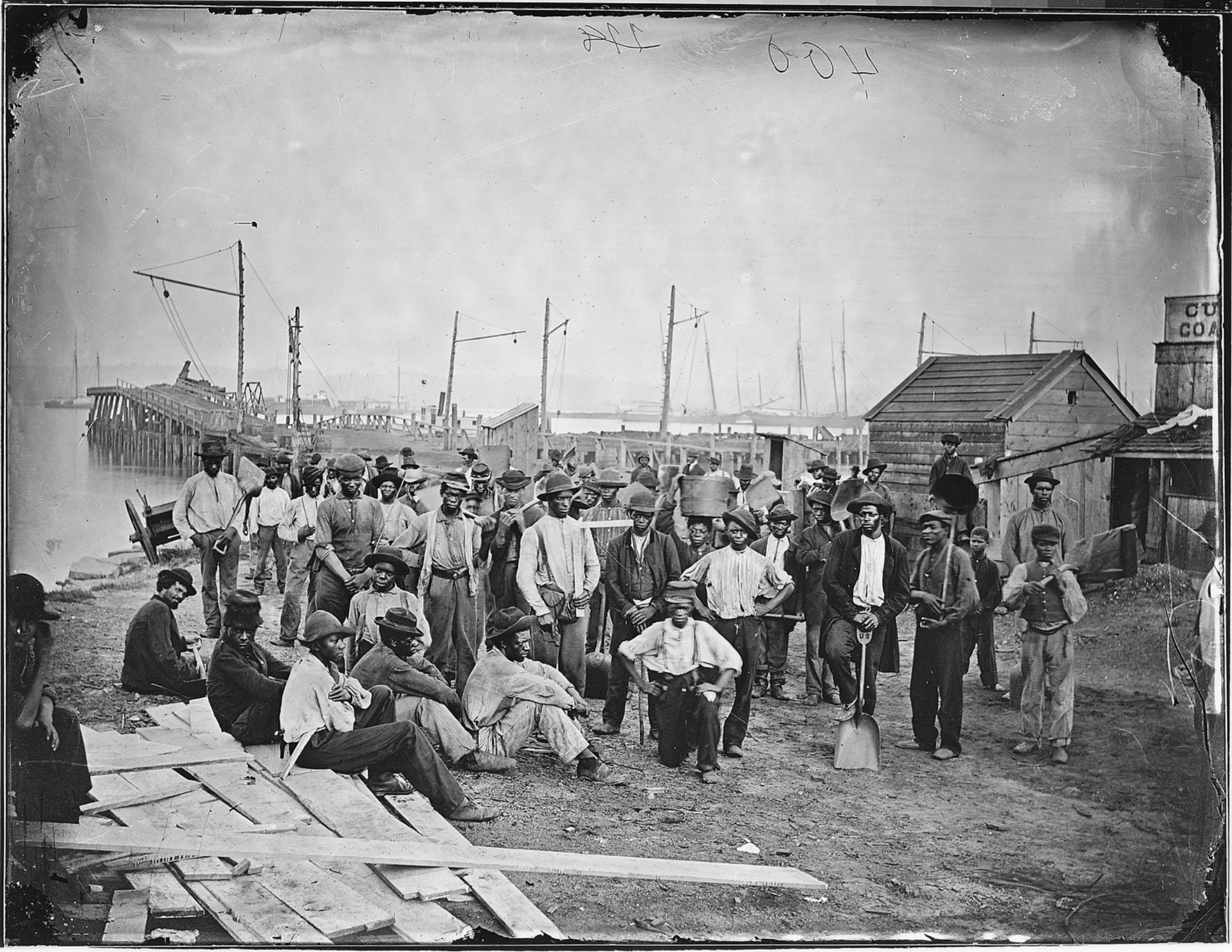
“[Black] laborers at Alexandria, near coal wharf” - National Archives (524820)
Union careers in construction remain one of the strongest pathways to a stable, family-supporting income for U.S. workers without a college degree. Yet access to those opportunities has never been equally distributed. The history of the “building trades”—the unionized crafts that build and maintain our physical infrastructure, including carpenters, electricians, plumbers, ironworkers, and laborers—is not only a story about wages, unions, and economic power; it is also a story about how race came to shape who could access the construction industry’s best jobs and who was left behind.
For Beyond the Bars, this story is personal. Our members work through temp agencies supplying labor to construction projects for rock-bottom wages and working conditions. This is only the latest expression of an economic order that has long relegated Black and immigrant workers to its most precarious jobs while reserving its greatest opportunities for white workers.
Over the next three editions of The Work Release, we’ll trace the history of the building trades in the United States: from their origins in medieval Europe, through the rise and fall of their power in the 20th century, to the labor market construction workers navigate today. Along the way, we’ll examine how race, work, incarceration, and power became intertwined, and what that history demands of us now.
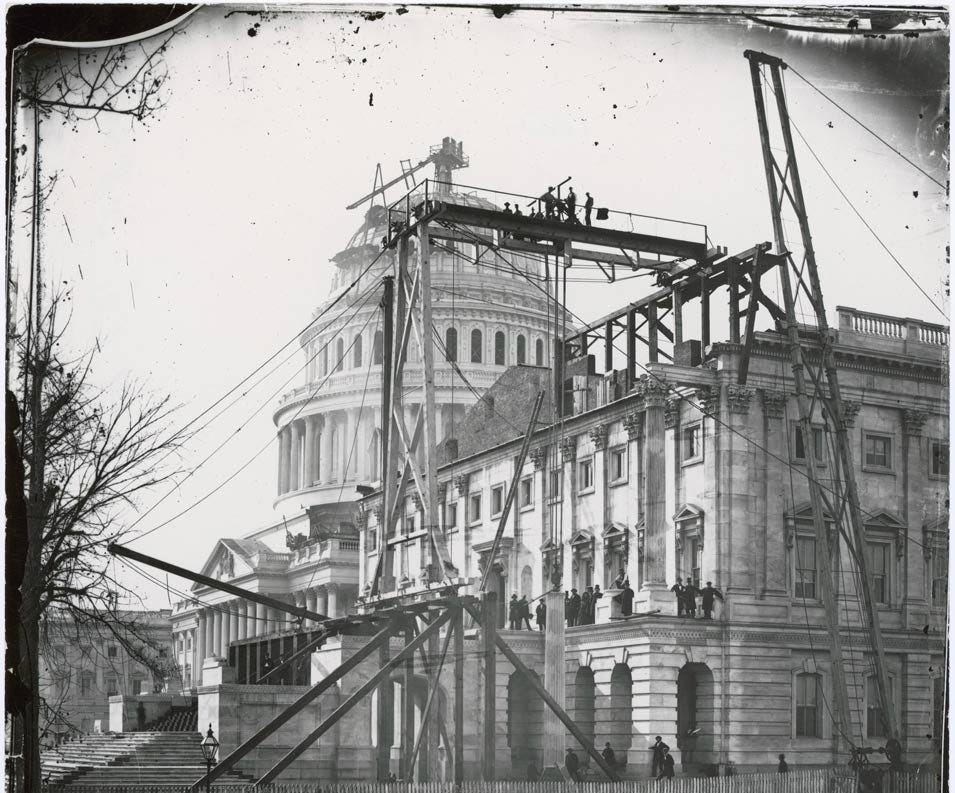
“Capitol Building Progress” - National Archives (121-BC-87B)
The Architecture of Division
The U.S. building trades were shaped by two forces that developed together: the institutions workers built to secure economic power and the racial order that structured who could access them. The opportunities and divisions that characterize the modern construction industry were built over centuries and can be traced back to medieval Europe.
The Guild System in Europe
The institutional logic of the American building trades can be traced to medieval Europe. Craft guilds—associations of masons, carpenters, blacksmiths, and other skilled tradespeople—controlled entry into construction work, set wage standards, and trained workers through a structured hierarchy: apprentice, journeyman, and master. An apprentice learned their trade while earning wages; a journeyman was a fully trained worker who hired out their labor; a master ran their own shop. This hierarchy remains recognizable in the American building trades today.
Guild members built many of the era’s most important structures: cathedrals, churches, fortifications, bridges, and public buildings. Access to these occupations meant more than a job. It offered specialized training, higher wages, social status, and, often, political power.
But the same institutions that created opportunity for some denied it to others.
Guild craftsmen worked on these projects alongside legions of day laborers, carriers, quarry workers, and servants. These workers were outside the guild system, performing physically demanding and poorly paid labor without access to the credentials, protections, status, or opportunities that guild membership provided. This is because guild membership required fees beyond the reach of the poor, family connections to existing membership, and acceptance into tightly controlled social networks. Women were largely barred from advancement and those deemed of the “wrong” ancestry, religion, or social standing were shut out altogether.
Over time, this produced a sharp division between guild craftsmen and workers excluded from the skilled trades. In many European cities, day laborers were prohibited from forming associations, restricted from gathering together, and subjected to intense surveillance and repression by political authorities and guild elites determined to preserve their economic privileges.
The result was a labor system organized around inclusion for some and exclusion for others, a pattern that would reappear in the U.S. construction industry.
Building America on Coerced Labor
In the seventeenth century, European colonists brought with them many of the core features of the guild system: apprenticeship, occupational hierarchy, and control over access to skilled work. These institutions took root in a colonial economy that was busy inventing race.
Colonial America was built on coerced labor. During the seventeenth century, roughly two-thirds of Europeans arriving in the colonies came as indentured servants, exchanging years of labor for passage across the Atlantic. Alongside them were growing numbers of enslaved Africans, forcibly transported and sold into bondage, as slavery increasingly became the engine of colonial economic development.
This was especially true in construction. Enslaved carpenters, masons, bricklayers, plasterers, and blacksmiths built the colonial built environment—often instead of, not alongside, free craftsmen. Enslaved craftsmen built the White House, the Capitol, and much of the major public and private construction of the early republic. At George Washington’s Mount Vernon in 1799, more than a quarter of the 184 enslaved people were skilled workers. Some arrived with construction knowledge rooted in West African building traditions. Others were put through the same apprenticeship structures as white workers—but unlike white apprentices, they remained enslaved after completing their training.
In the 17th century, the legal boundaries separating the indentured servants from Europe and enslaved people from Africa were not yet fully settled, and colonial elites were deeply concerned about the possibility of collective resistance from those at the bottom of society. In 1676, European and African workers in Virginia fought together in Bacon’s Rebellion, the largest colonial insurrection before the Revolution. For the planter elite, the rebellion exposed a dangerous possibility: that exploited workers might identify their shared interests across ethnic and national lines rather than with the colonial ruling class.
Their response was deliberate. Over the following decades, the Virginia Assembly constructed a legal architecture of racial difference. European workers, however poor, gained rights denied to African workers—to bear arms, move freely, testify in court, own property, and eventually claim membership in a newly created social category: “white.” African workers were consigned to permanent, hereditary bondage. Similar laws soon spread throughout the colonies, enshrining racial hierarchy as a defining feature of American society.
By the late nineteenth century, the racialized foundations of the American labor market had been laid and endured long after 1865, when slavery was formally abolished. Enslaved Black people had helped build the nation’s roads, ports, public buildings, and early cities, while successive waves of European immigrants were gradually incorporated into the category of “white” and gained access to opportunities and mobility denied to Black workers. The modern building trades would emerge within this racial order.
The Rise of the Modern Building Trades
By the mid-nineteenth century, the construction industry was undergoing a profound transformation. Railroads stretched across the continent, cities expanded rapidly, and construction projects grew larger and more complex than anything the old craft system had been designed to handle. The independent master builder who once oversaw a project from start to finish increasingly gave way to a new figure: the general contractor.
As construction scaled up, so did the labor market. Contractors were no longer limited to hiring workers from a single city or region. Improvements in transportation and communication allowed employers to recruit workers across state lines and import strikebreakers when local workers organized for better conditions. The local craft associations that had once governed construction work struggled to confront employers operating on a national scale.
Craft workers responded by building national organizations of their own. The Bricklayers, Masons and Plasterers International Union was founded in 1865. The United Brotherhood of Carpenters and Joiners followed in 1881. These unions sought to do for workers what contractors were increasingly doing for employers: grow and coordinate power across local boundaries.
Most craft worker organizations—collectively known as the building trades unions—were exclusionary from the start. Most affiliated with the American Federation of Labor after its founding in 1886. The AFL organized skilled workers by trade rather than by industry, and racial exclusion was built into that model. Unions with explicit racial bars in their constitutions were admitted. Black workers were systematically excluded from union ranks or, at best, organized into subordinate locals; separate, weaker branches with little power over union decisions.
This exclusion was reinforced by the political culture of the building trades. The craft unions developed a form of business unionism centered on protecting a limited pool of skilled workers, maintaining control over local labor markets, and supplying contractors with labor on an as-needed basis. Many local union leaders had close day-to-day relationships with employers and saw their role less as organizing the unorganized than as administering access to jobs, training, and benefits for those already inside the system. Growth was often treated as a threat: expanding membership meant more workers competing for a fixed number of jobs.
This is how the hiring hall became the central institution connecting workers to work. When a worker needed employment, they registered at their local union hall. When a contractor needed labor, they called the hall, and a dispatcher referred workers, usually by seniority or rotation. This gave unions enormous power over who worked and who did not.
Apprenticeship control was the mechanism through which exclusion operated at every level. If a union controlled who entered the apprenticeship, it controlled who became a journeyman, who got dispatched, and who could work on union sites at all. This happened not only through dramatic acts of discrimination, but through ordinary institutional practice—every committee meeting, every referral that went to a member’s son instead of a stranger, every apprenticeship slot filled through an existing relationship.
Beneath the trade unions, a separate workforce, referred to as the “laborers,” did the work that made other tradework possible: digging foundations, carrying materials, mixing mortar, clearing debris. This tier—heavily immigrant and Black—was where workers who were not admitted into the union trades were deposited.
In 1903, laborers formed their own national institution, now known as the Laborers’ International Union of North America (LIUNA), in recognition of what the craft unions had made clear: they could not rely on those organizations to represent their interests.
By the twentieth century, these patterns had hardened. Building trades unions held real power where they controlled work, but that power was fiercely guarded through exclusion rather than expanded through organizing. The system had created good jobs for some workers, but it had done so by narrowing the circle of who could enter.
The Door Half-Open
The Congress of Industrial Organizations (CIO) emerged in the 1930s to challenge the AFL’s craft-union model. Where the AFL organized workers by trade, the CIO sought to organize entire industries, bringing “skilled” and “unskilled,” native-born and foreign-born workers together. In theory, this model challenged the narrow craft exclusivity that had defined the building trades.
The sitdown strikes of 1936/1937—where workers occupied factory floors in Flint, Detroit, and across the industrial Midwest rather than walking out, denying employers the ability to bring in strikebreakers—drew in 400,000 workers at their peak. Tens of thousands of Black workers entered union membership alongside immigrant and native-born white workers as genuine members, not subordinates.
But the solidarity had racial limits that would prove fatal.
In 1943, white workers struck against the upgrading of Black workers in wartime factories, resulting in over 100,000 days of work lost. At the Packard Works in Detroit, 25,000 white workers struck in retaliation for a brief sit-down by Black workers protesting their exclusion from promotion. The same year, Detroit erupted into anti-Black violence that took thirty-four lives.
The CIO cracked the door open wider than the AFL had, but it did not undo the racial order that structured American work. Industrial unions brought more Black workers into organized labor, but many white workers still treated Black advancement as a threat. In the building trades, the door remained as tightly controlled as before. The promise of industrial unionism—that worker power could be built across skill, race, and nationality—collided with the older logic of craft exclusion.
That contradiction was cemented by federal labor law. In 1931, Congress passed the Davis-Bacon Act, requiring contractors on federal construction projects to pay locally prevailing wages: the standard wage and benefit rate for each trade in a given area, which often reflected union wage standards where unions were strong. Four years later, the National Labor Relations Act (NLRA) of 1935, also known as the Wagner Act, guaranteed many workers the right to organize and required employers to bargain in good faith. Together, these laws strengthened the labor standards attached to jobs already inside the formal labor market.
But these laws did not equally protect all workers.
The Wagner Act excluded agricultural and domestic workers—industries heavily populated by Black workers. These exclusions were the price of Southern Democrats’ support for the bill. Organized labor, which had the political weight to push back, stayed silent. The result was a federal labor regime that raised standards for some workers while leaving many of the most exploited workers outside its protection.
The Great Migration intensified these contradictions. During the 20th century, six million Black people left the South, fleeing Jim Crow segregation, racial violence, and limited economic opportunity. Many arrived in northern cities with generations of craft experience in construction. But the most stable and well-paid construction jobs were controlled by the building trades, which were overwhelmingly white.
In the early 1960s:
In Chicago, Black workers represented 3.8% of union electricians, 0.7% of union carpenters, and 0.1% of union sheet metal workers.
In New York City, 92% of building trades union members were white, including every single one of the 3,300 members of Sheet Metal Workers Local 28.
(Mark Erlich, The Way We Build: Restoring Dignity to Construction Work, 2023)
As James Baldwin said in his 1965 appearance on the Dick Cavett Show:

Civil Rights at the Hiring Hall
Black workers had been organizing against exclusion from the labor movement long before the civil rights campaigns of the 1960s. In 1925, Frank Crosswaith founded the Trade Union Committee for Organizing Negro Workers in New York City, laying the groundwork for what would become the Negro Labor Committee, which he chaired until his death in 1965. That same year, A. Philip Randolph founded the Brotherhood of Sleeping Car Porters, the first predominantly Black union to receive an AFL charter. Together, Crosswaith and Randolph spent decades arguing that the labor movement could not fulfill its own promises while excluding Black workers, and organizing to make that case from inside the movement. In 1960, after the AFL-CIO refused to adopt internal desegregation measures, Randolph founded the Negro American Labor Council to pressure the federation to eliminate Jim Crow locals and open apprenticeship programs to Black workers.
By the early 1960s, exclusion from the building trades had become a central issue within the Civil Rights Movement. The 1963 March on Washington was explicitly a march for “Jobs and Freedom.” Its route passed construction sites in Washington, D.C., where Black workers were excluded from union jobs on federally funded buildings. Direct action campaigns followed in cities across the country, with workers and activists physically blocking construction sites to demand access to union jobs that had long been closed to them.
The most significant federal response was the Revised Philadelphia Plan, implemented by the Nixon administration in 1969. Building on an earlier Johnson-era effort, the plan required federal construction contractors in Philadelphia to set goals and timetables for hiring minority workers in the building trades.
It was the first major affirmative action program applied to the construction industry.
Nixon’s support was both substantive and political. The Revised Philadelphia Plan advanced federal affirmative action in one of the country’s most exclusionary, high-wage industries, but it also exploited a fracture inside the New Deal coalition: between civil rights organizations demanding access to construction jobs and building trades unions determined to preserve control over hiring halls and apprenticeship programs. This in turn weakened a key Democratic constituency and exposed tensions between labor’s civil rights rhetoric and the exclusionary practices of many building trades unions.
Federal intervention did not end the fight. Black workers and their allies continued organizing, protesting, suing, and challenging the unions from within. In 1972, Black union members founded the Coalition of Black Trade Unionists (CBTU). Its mission was broader than construction, but its politics spoke directly to the building trades: confronting racial discrimination was central to the struggle for worker power.
What This History Demands
The building trades built real power for working-class people. Through apprenticeship programs, hiring halls, collective bargaining agreements, and political organization, workers created pathways into skilled work that could support a family, buy a home, secure health care, and retire with dignity. In many cities, the trades became political forces in their own right, shaping public infrastructure, private development, and elections themselves.
These were material gains won through sacrifice and struggle. But those same institutions were built with the door closed to Black workers, women, and others deemed outside the circle, and keeping that door closed weakened the movement that built them.
Naming that is not an indictment of unionism. It is the precondition for building a labor movement that lives up to its own promises.
The struggles led by Black workers that forced those institutions to open—the direct action campaigns, the workers who physically blocked job sites to demand inclusion—are also part of this history. Progress is won by organized people fighting for it.
Today, workers with criminal records—largely Black and Latine—are pushed into a new version of that old exclusion. They may work in construction, but too often through temp agencies and informal labor systems that are outside of the building trades.
Our task is not only to help workers access existing union jobs. It is to expand the universe of union work itself, so that its wages, benefits, training, and safety standards extend to all temp workers performing construction labor from the margins.
History is contested, and we don’t claim to have it all right. If something here doesn’t sit right with you—a fact, a framing, an omission—tell us. We welcome corrections, additions, and pushback from our readers.
Next month, in Part Two of this series, we pick up the story of the last fifty years, tracing the rise of neoliberalism, the decline of union density, and the emergence of the labor market that workers with records navigate today.
In place of a poem this month, we close with a video (linked in image) and the words carried by Black sanitation workers in Memphis in 1968: “I AM A MAN.”

[Video: I AM A MAN - The Memphis Sanitation Workers Strike of 1968]
In Memphis, more than 1,300 workers—nearly all of them Black —were paid just $1 an hour, with no uniforms, restrooms, union recognition, or grievance procedures for the countless times they were underpaid.
When two workers, Echol Cole and Robert Walker, were crushed to death sheltering from the rain inside a garbage compactor, the city refused accountability.
The workers walked out on February 12, 1968, demanding safe conditions, fair wages, and union recognition. Martin Luther King Jr. came to Memphis to stand with the strikers and was assassinated there on April 4, 1968.
The workers won their union contract one month later.
“I AM A MAN” reminds us that the struggle for worker power has always been a struggle over who is seen as fully human, and therefore deserving of safe work, fair wages, dignity, and the protections workers have fought and died for.
The demand at the heart of “I AM A MAN” still echoes today. Join us at an upcoming event to stand with workers with records fighting for safety and dignity on the job.
Coming Up
BTB Team Meetings
Beyond the Bars Office/Zoom - 1951 NW 7th Ave, Miami, FL 33136
Are you a member of Beyond the Bars who is interested in getting more involved? Join one of our team meetings! Each team has an area of focus that contributes to the overall campaign of organizing temp workers with records in the construction industry. Link up to learn, share and develop your skills! BTB members, contact your organizer to join one of these meetings.
Civics (Policy & Political Education) - Thursday, June 18th | 12:00pm (Hybrid)
Solidarity (Mutual Aid) - Every Wednesday | 5pm (Hybrid)
AirWars (Arts & Communications) - Thursday, June 18th | 5:30pm (Hybrid)
Labor Notes Conference June 12-14 | Chicago, IL
From June 12-14, we’re heading to Chicago for Labor Notes, joining more than 5,000 rank-and-file workers to present our work organizing temp workers with records in the construction trades. Join us in the following sessions!
Beyond Bread and Butter: Expanding What We Bargain For (Friday, 1:00–2:45 PM | Grand Ballroom C)
FILM: The Alabama Solution: Organizing Workers In And After Prison (Saturday, 9:00–10:45 AM | LAX)
How To Keep Going: A Workshop On Organizing When It’s Hard (Saturday, 2:15–4:00 PM | Grand Ballroom B)
Southern Workers Meeting (Sunday, 9:00–10:00 AM | Heathrow)
Juneteenth FIFA Watch Party (Friday, June 19th | 7:30pm)
Randy’s Restaurant and Lounge - 13420 NW 7th Ave, Miami, FL 33168
Beyond the Bars is co-hosting a watch party for the Brazil vs. Haiti FIFA match! Join us at Randy’s Restaurant in Miami for food, drinks, prizes and Juneteenth history.
General Body Meeting (Saturday, June 20th | 2:00-5:00pm)
Breezeswept Tot Lot - 12519 NE 2nd Ave, North Miami, FL 33161
Our third GBM of the year will be an outdoor social and introduction to our new BTB Teams. Come to Breezeswept Tot Lot in North Miami for BBQ, team games and playgrounds/waterpads for the kids. You’ll meet current team leaders and choose which BTB team to join (Civics, Solidarity, Turf, AirWars, Research, Union)!
FIFA Watch Party (Saturday, June 27th | 6:30pm)
Las Carnitas - 3221 Davie Blvd, Ft. Lauderdale, FL 33312
Beyond the Bars is co-hosting a watch party for the Colombia vs. Portugal FIFA match! Join us at Las Carnitas in Fort Lauderdale for free food, drinks, prizes and some World Cup labor history.
For Part I of this series we drew on the following texts as part of our research. We encourage you to look into them yourselves to dig deeper into the history of race and construction in the United States.
Article References
Asad Haider, Mistaken Identity: Mass Movements and Racial Ideology (2018)
Barbara J. and Karen E. Fields, Racecraft: The Soul of Inequality in American Life (2012)
Mike Davis, Prisoners of the American Dream: Politics and Economy in the History of the US Working Class (1986)
Mark Erlich, The Way We Build: Restoring Dignity to Construction Work (2023)
Nell Irvin Painter, The History of White People (2010)
Silvia Federici, Caliban and the Witch: Women, the Body and Primitive Accumulation (2004)
Theodore W. Allen, The Invention of the White Race (1975)
W.E.B. Du Bois, Black Reconstruction in America (1935)
If our work resonates with you, here are ways to take action with us.
Take Action
Learn More → beyondthebars.org
Stay Updated → @beyondbars_mia
Take Action → Sign up to volunteer