


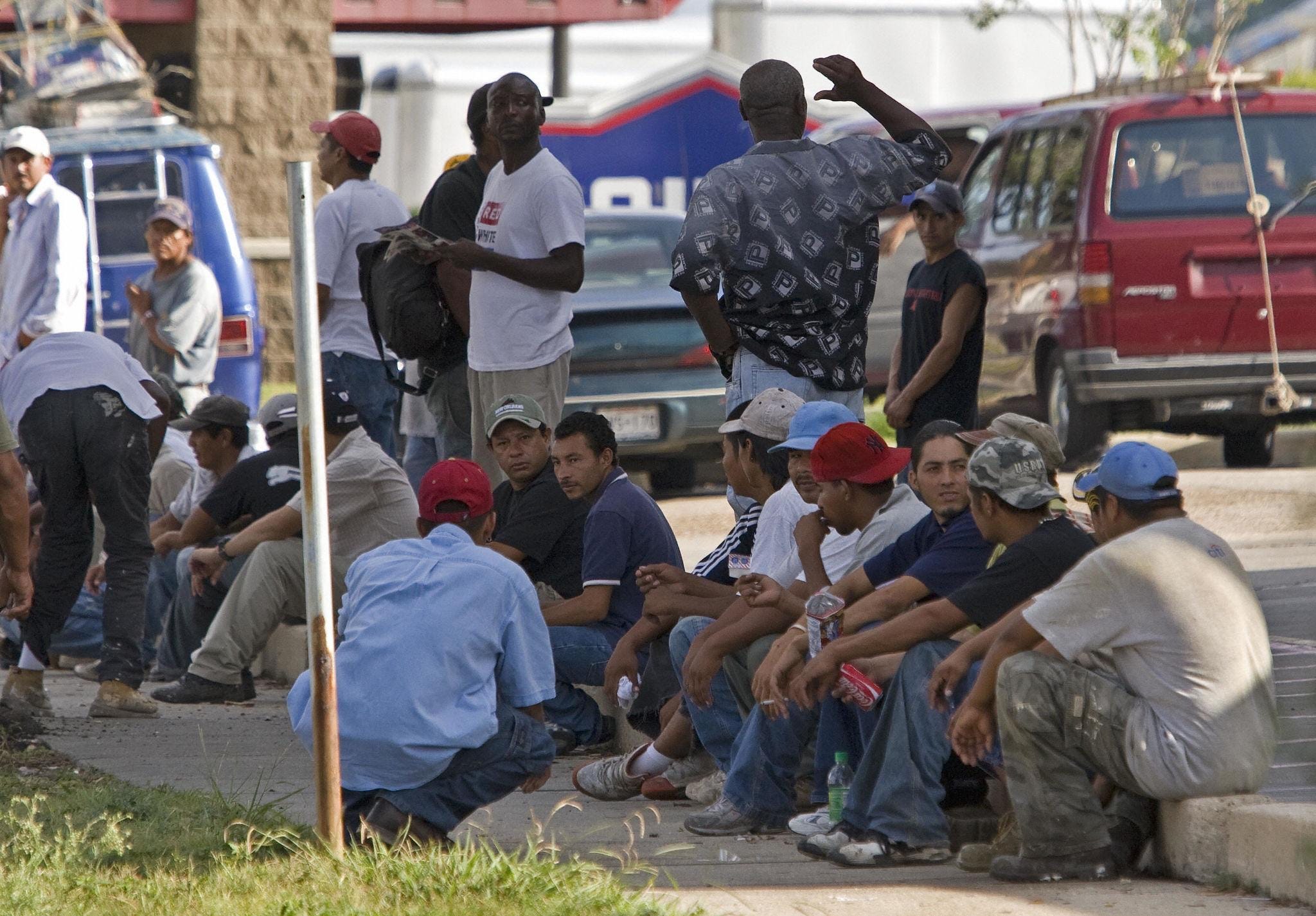
People gather in New Orleans in January 2006, seeking construction work after Hurricane Katrina. Photograph by Ben Margot/Associated Press. Source: UC Berkeley Human Rights Center.
In Part I: The Architecture of Division, we traced how the modern building trades unions developed within America’s racial order. Apprenticeships and hiring halls gave unions enormous control over entry into electrical work, plumbing, carpentry, ironwork, and other skilled trades—and thus, over who gained access to the training, wages, and security they offered. For generations, many unions used that control to exclude Black workers, relegating them to construction’s lowest-paid jobs. Part I ended as Black unionists during the Civil Rights Era forced that door open.
But just as Black workers won entry, those very institutions were losing their power. In 1971, roughly 60% of blue-collar construction workers were covered by a union contract. By 2025, unions represented just 12% of the construction labor market.
Part II follows this transformation. It examines how large corporate construction users, developers, and contractors reorganized the industry to break unions’ hold over the labor supply, and the contracting structures they built to do it. It also traces how the expanding carceral system and an increasingly punitive immigration regime pushed growing numbers of Black and immigrant workers into the most precarious parts of the nonunion construction market, where criminal records, immigration status, and state supervision gave employers additional leverage over their labor.
The Great Unmaking; or, How Corporations Built the Nonunion Construction Industry
Construction has never offered the stability of a factory job. A project begins, and workers move in and out as their specialties are needed—excavators and foundation crews first, then framers, then electricians and plumbers, then finishers—each trade’s work winding down as the next one’s begins. The building rises, fills in, and is completed. Then everyone moves on.
The central achievement of building-trades unionism was to organize a career across employers rather than depend on any single contractor to provide one.
Hiring halls matched contractors that needed labor with workers who needed the next job. Apprenticeship programs trained each new generation. Collective bargaining established area wages and working conditions. Jointly administered health and retirement funds made benefits portable. When one project ended, a worker didn’t have to begin from zero with the next employer.
At the height of union construction in the mid-twentieth century, this system solved problems for contractors. Most construction firms were small, with little capacity to recruit, train, and maintain a permanent workforce, since their need for labor constantly expanded and contracted. Unions supplied skilled workers when contractors needed them and administered much of the training, benefits, and job-referral system.
As Mark Erlich wrote, building-trades unions effectively served as the human-resources department for the entire construction industry.
The system worked because unions represented enough of the workforce that contractors had to operate within the standards unions had established. From the late 1940s through the early 1970s, when building-trades unions represented more than half the industry, construction became one of the country’s highest-paid blue-collar occupations. The work remained dangerous, seasonal, and physically punishing, but a union card could make it the foundation of a secure life.
That was the union difference: collective institutions converted a sequence of short-term jobs into a career.
But the same control over entry that gave workers leverage was also used to exclude. Apprenticeship slots often passed from father to son. Local autonomy allowed some unions to maintain segregated membership and referral systems even when their international unions formally opposed discrimination.
Once corporations found a way around unions’ control of the labor market, they had an excluded workforce to draw from.
Corporations Organized the Industry
By the late 1960s, major oil, chemical, steel, manufacturing, and utility corporations set out to reduce their dependence on building-trades unions for skilled labor. These companies regularly commissioned refineries, factories, power plants, and other facilities essential to their operations. Together, they were among the country’s largest corporate buyers of construction. Unlike the mostly small and locally-based contractors they hired to execute their projects, these corporations had the resources, reach, and demand to pursue a strategy across projects and regions.
Their gripes extended beyond union wages. Large projects were built in sequence: steel couldn’t go up before foundations were poured; walls couldn’t be closed before electricians and plumbers finished their work. A strike over wages and working conditions involving one trade could therefore shut down an entire site, delaying production and profits.
In 1969, executives from the country’s largest corporations, including Monsanto and U.S. Steel, formed the Construction Users Anti-Inflation Roundtable. Three years later, the group became part of the Business Roundtable, which would grow into one of the country’s most powerful corporate policy organizations. Through the Roundtable, corporations that had previously approached construction project-by-project began coordinating their purchasing power and strategy across the entire industry.
Roundtable members steered contracts toward non-union contractors. They helped expand the Associated Builders and Contractors (ABC), founded by seven Baltimore contractors in 1950, into a national counterweight to contractor associations whose members bargained with the building trades. They attacked prevailing-wage laws, union hiring halls, protections that kept subcontracted work under union agreements, and shared benefit funds that allowed workers to carry health and retirement coverage from one contractor to the next. They also promoted “double-breasted” companies, which maintained a union operation for projects where union labor remained necessary and a nonunion operation that could perform work outside the union agreement.
They also helped change what a general contractor was.
Subcontracting was not new to construction. But large general contractors had traditionally employed substantial crews of carpenters, laborers, masons, and other workers directly. Under the new model promoted by these corporate buyers, general contractors increasingly managed contracts, schedules, and budgets while subcontractors hired the workers and assumed more of the risk.
The result: the rise of the “fissured workplace,” where corporations at the top retain control over what must be built, by when, and at what price, while becoming increasingly removed from the people building it. Labor becomes less a question of what workers should earn than how cheaply each contractor can deliver its portion of the job.
Between 1967 and 1997, general contractors’ share of direct construction employment fell from 35 percent to 24 percent, while specialty subcontractors’ share rose from 48 percent to 63 percent.
Law and public policy reinforced this shift, as, around the same time, deregulation and declining government support for unions became part of a broader political turn called neoliberalism. The rules increasingly enabled corporations to coordinate across companies and projects while limiting workers’ ability to do the same.
By the mid-1980s, twenty of the country’s twenty-five largest construction firms operated both union and nonunion divisions. Corporate buyers could draw on union labor when they needed it and route work around union standards when they didn’t. Construction remained fragmented, but the corporations directing it were no longer acting alone.
Corporations had organized the construction industry.
Workers Paid the Price
As corporations reorganized construction outside union control, the building trades largely fought to protect the work they still had. Rather than organizing the growing nonunion workforce, many locals restricted their own membership, negotiated for existing members, and treated workers outside the union as competitors. This became known as organizing “the work, not the workers.”
George Meany, who rose through the Plumbers before becoming the first president of the AFL-CIO, put it bluntly:
“We didn’t want the people…we merely wanted the work.”
That strategy reflected the craft structure itself. Trades guarded their own work, and internationals guarded their autonomy from one another—divisions that made cooperation difficult even among unions facing the same employers. Locals, meanwhile, guarded their jurisdictions, leaving little room for workers who didn’t fit neatly within an established craft, or whose admission they felt threatened existing members’ access to jobs.
The consequences were severe. During construction booms, some locals brought in temporary “permit men” without admitting them as members. When work slowed, they were dismissed, taking the skills they had learned on union jobs into the nonunion industry. As one business agent later admitted, “We basically taught them the trade and then we said, ‘We don’t have any use for you.’”
This excluded workforce helped fuel nonunion residential construction in the suburbs and the expansion of nonunion contractors across the South and Southwest.
Race continued to shape who remained outside the hiring hall. As union market share shrank, integration could look to white journeymen like dividing a shrinking pool of jobs. The Black apprentice appeared to be the visible threat, while the corporations steering projects to nonunion contractors were the actual architects.
Race turned white workers’ fear against workers of color, while employers reorganized the industry around them.
Temp agencies and labor brokers increasingly became the informal hiring halls of the expanding nonunion construction industry, assembling crews quickly and sending them wherever contractors needed labor—but without the common standards, benefits, or path to a career provided by union hiring halls. As immigrant workers entered construction in growing numbers, labor brokers exploited their immigration status, language barriers, and fear of retaliation.
As corporations were restructuring construction and expanding the nonunion industry, the state was expanding the carceral system as part of the new neoliberal order. Angela Davis makes the mechanism explicit:
Corporations closed shop to escape organized labor, "leaving [Black people] prey to the drug trade, destroying the economic base of these communities... and turning the people who live in those communities into perfect candidates for prison."
And as growing numbers of people returned from prison, temp agencies became a new and important entry point into the construction industry, dispatching workers to short-term cleanup, demolition, and general-labor jobs. Criminal records shut many workers out of more stable employment, while probation and parole often required them to remain employed. Temp agencies exploited both constraints: the carceral system pushed workers into the contracting chain with fewer options and greater consequences for refusing or losing a job.
The contracting system rewarded whoever could deliver labor most cheaply, whether through genuine efficiency or by paying cash, evading overtime, misclassifying employees, or understating workers’ compensation payroll. Repeals of prevailing-wage laws and limits on federal enforcement against misclassification gave these practices room to spread.
This corporate offensive changed the standard for the entire industry. During the 1980s and early 1990s, construction union density fell by one-third—from 33 percent in 1981 to 22 percent in 1992—while real wages across union and nonunion construction fell 17 percent. By 1999, the wage advantage construction workers had once held over the median worker had nearly disappeared.
Many unions tried to make union contractors more competitive by accepting wage cuts, lower premiums, relaxed work rules, and other concessions. But concessions could not solve a problem created by weak market power: nonunion contractors could lower their wages and benefits even faster, restoring the same competitive gap at a lower floor.
The consequences of exclusion therefore did not stop with the workers denied entry. A union can defend high standards only when it organizes enough of the labor market to make those standards difficult to evade. Every workforce abandoned to the nonunion sector became a workforce employers could hire on worse terms—and invoke when telling union members that their wages, benefits, apprenticeship programs, and safety rules cost too much. The more the trades treated Black, immigrant, and other nonunion workers as a threat outside the union, the more useful those workers became to employers as an alternative to it.
White union workers did not gain lasting security from a labor market in which employers could pay other workers less. They inherited a shrinking island of high standards in a growing low-wage sea.
Organize the Workers and the Work
Some trade leaders drew a different lesson from the industry’s decline. Concessions might temporarily make union contractors more competitive, and top-down agreements might secure individual projects, but neither could restore union power while contractors remained able to find labor outside the hiring hall.
Organizing those workers required unions to overcome resistance within their own ranks. Union members who were between jobs often waited on an “out-of-work list” to be referred to the next union job. Many feared that bringing nonunion workers into the union would add more people competing for the same limited pool of work—and make existing members wait longer. Local leaders faced a political risk as well: organizing a nonunion contractor could bring its entire crew into the union at once, angering current members and changing the balance of power in the next union election. Generations of members had been taught that restricting entry protected their jobs.
The International Brotherhood of Electrical Workers (IBEW) developed a strategy aimed at both sides of this divide. To reach workers outside the union, IBEW locals revived “salting,” allowing union members to take jobs with nonunion contractors and organize from within. To overcome resistance inside the union, the IBEW worked with Cornell University’s Construction Industry Program to launch COMET—the Construction Organizing Membership Education Training program—in 1990.
COMET trained union representatives to lead members through discussions about declining market share, falling wages, concessionary bargaining, and resistance to organizing nonunion workers. Its purpose was to confront the belief that workers outside the union were the source of the industry’s declining standards—and to show that continuing to exclude them would only deepen the “race to the bottom.”
The shift was incomplete and fiercely contested. But it recovered a strategic truth that the corporate offensive had exposed: unions don’t build power by managing scarcity for a shrinking membership.
They build power by organizing the workers and the work—until employers can no longer evade the standard.
As we noted in June’s Work Release, we’re learning as we go and don’t claim to have every framing or fact right. We welcome corrections, additions, and pushback, because how we understand this history shapes how we organize. Reach out to share yours—and tune in this October for Part III, the final installment in this series, which brings the analysis into the present, follows power up the contracting chain, and examines the levers for change.
Before turning to what we’re reading, we pause with an image of the workers at the center of this history, as builders whose work is inseparable from one another.
Jacob Lawrence, The Builders (1947)
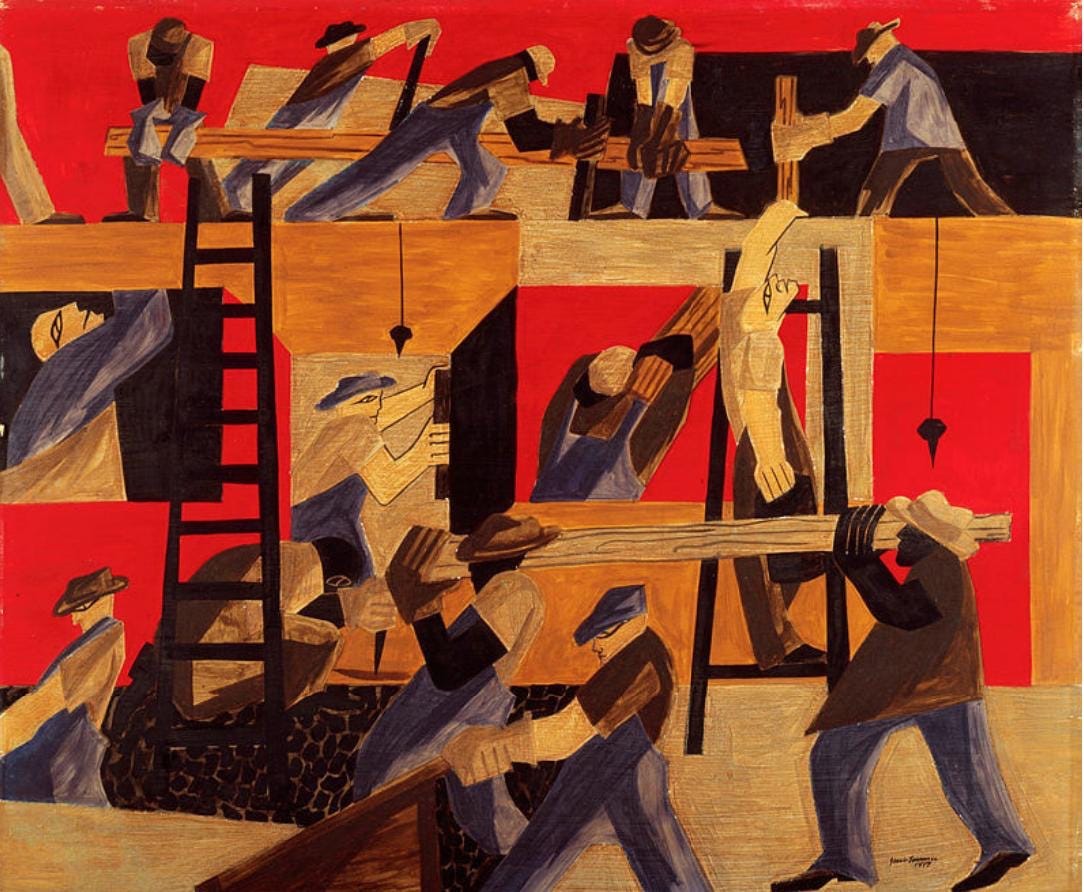
Jacob Lawrence, The Builders, 1947. Tempera on board, 20 × 24 inches. White House Collection; gift of the White House Acquisition Trust. © 2020 The Jacob and Gwendolyn Knight Lawrence Foundation, Seattle / Artists Rights Society (ARS), New York. Source: White House Historical Association.
Builders were a recurring subject in Jacob Lawrence’s paintings and prints from the mid-1940s through the 1990s. For him, they symbolized human aspiration—“man building,” as he described it. Here, workers, tools, ladders, and beams lock together into a single dense structure. No worker stands apart, and no building takes shape through one pair of hands. Lawrence places Black workers at the center of the frame—not behind the world they are constructing, but as its makers. The painting captures an idea at the heart of this issue of The Work Release: building is collective, and so is the power to change its terms.
The books below take up that same question in prose: how systems of work divide and discipline people, and how organizing can return power to working people.
What We’re Reading
Adam Reich, Inside Jobs: Prison Work in the American Labor Market (2026).
Adam Reich traces the relationship between prison labor and the broader American labor market across two centuries, showing how incarceration has repeatedly been used to discipline workers, lower labor costs, and manage unemployment. He examines how employers increasingly treat criminal records not simply as a stigma, but as a source of workers made vulnerable and dependent by incarceration. By connecting work inside prisons to employment after release, Reich reveals how the carceral system disempowers workers on both sides of the prison wall—and points toward efforts to build a more just alternative.
Erica Smiley & Sarita Gupta, The Future We Need: Organizing for a Better Democracy in the Twenty-First Century (2022)
Erica Smiley and Sarita Gupta argue that collective bargaining must evolve beyond wages and working conditions to give workers genuine governance over their lives. Weaving together stories of real working people, they position the fight for collective bargaining power as central to building a healthy democracy, naming the struggle against racial and gender discrimination as inseparable from that project. The book offers both an analysis of existing levers of worker power and a vision for the new ones we must build.
Grace Palladino, Skilled Hands, Strong Spirits: A Century of Building Trades History (2005)
Grace Palladino traces a century of building-trades history, examining how fiercely autonomous building trades unions worked together—and often clashed—over jurisdiction, organizing strategy, and the direction of the industry. She shows how the trades built institutions capable of improving safety, expanding union construction, and uniting workers across crafts, while internal divisions repeatedly limited their collective power. The book’s final chapters follow the movement’s response to declining market share, including the development of COMET and renewed efforts to organize nonunion workers.
If our work resonates with you, here are ways to take action with us.
Take Action
Fuel the Work → Donate now
Learn More → beyondthebars.org
Stay Updated → @beyondbars_mia
Take Action → Sign up to volunteer