


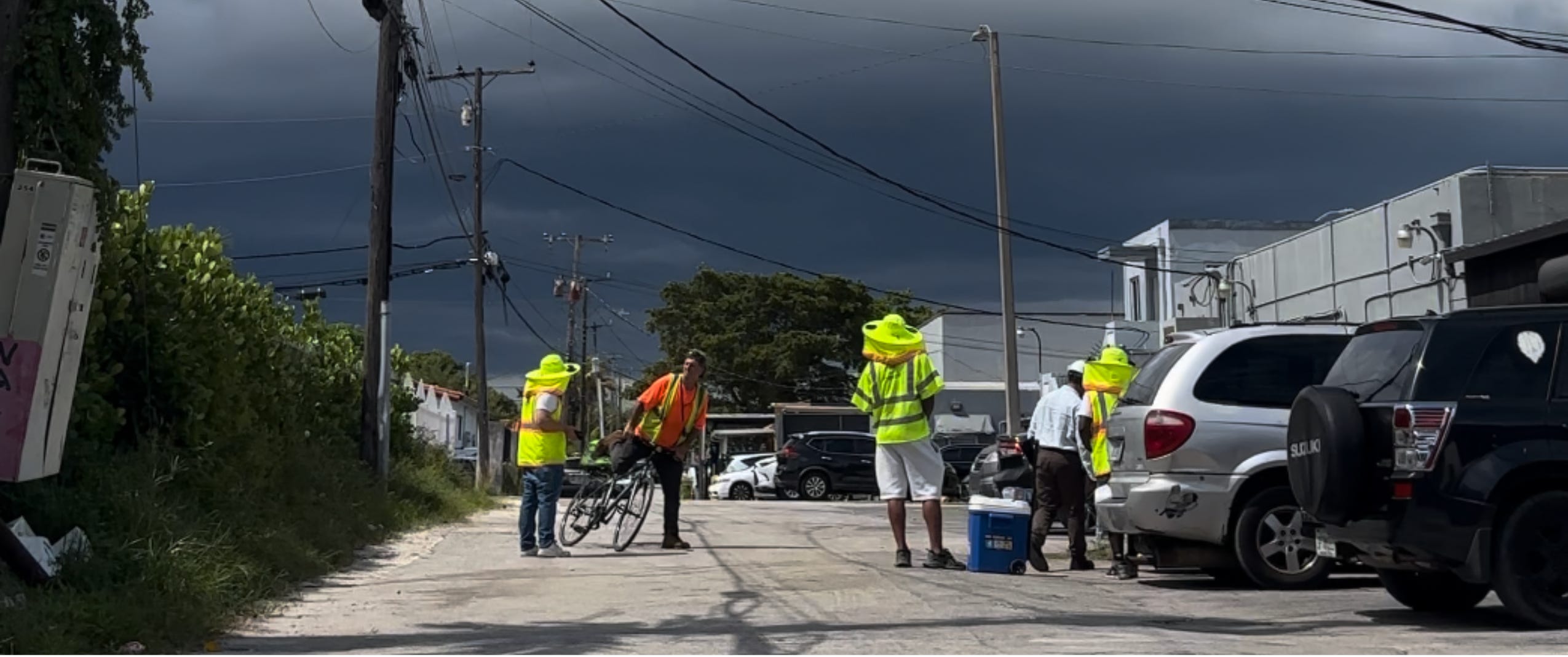
Workers return to a South Florida temp agency in the afternoon to collect their pay after a day building luxury condos and office buildings in Miami. Photograph by Filipe de Sousa, Beyond the Bars.
In Part I: The Architecture of Division, we traced how building-trades unions created hiring halls, apprenticeships, portable benefits, and area wage standards that turned a sequence of short-term construction jobs into high-quality careers, while at the same time, keeping Black and immigrant workers out.
In Part II: The Great Unmaking, we examined how corporations exploited those divisions and reorganized construction across projects and geographies, eroding building-trades unions’ control over the labor market. The result was a “fissured” industry: corporations at the top retained power over the industry while employment moved down a chain of subcontractors, temp agencies, and labor brokers that increasingly employed people with precarious legal status, including people with criminal records and immigrants without work authorization.
In Part III: Rebuilding Worker Power, we bring this history into the present, offering our perspective on what it might take for unions and worker centers to reorganize the industry without reproducing the exclusions of the past. We offer South Florida as a case study of a high-growth Southern market where fewer than 2% of workers in the trades our members work in belong to a union. We hope the analysis and suggestions here are helpful to others organizing in similar markets.
A note: This installment of Race Under Construction was written for organizers and researchers in labor unions, worker centers, and organizations interested in industry-based strategic campaigning. While we did our best to explain insider terminology, the content is technical at times. We recognize this choice may lose some readers who have been following along with this series, and for that, we apologize in advance. If that’s you, please don’t be deterred. We’re more than happy to talk through the content. Just email maya@beyondthebars.org.
Rebuilding Worker Power; or, Organizing in a Nonunion Construction Market
Joseph*, a Haitian temp worker, pulled up his pant leg to show an organizer the GPS monitor on his ankle. He had court that Monday. Until recently, he had been houseless, sleeping outside. Work through a temp agency gave him just enough income to share an efficiency with another person.
That day, the agency had sent Joseph to a 41-story luxury high-rise in Edgewater, where future residents will have a pet spa, a cold plunge, and a yoga studio. He spent the day sweeping floors, moving sandbags, and hauling debris in heat that felt like 110 degrees.
The agency pays Joseph $100 a day. Rent is high, food is expensive, and he said he is just trying to survive. He wants to be paid more, but if he raises a concern, he believes he will never see another work ticket. He wants to join a union because, to him, it’s important for people to band together. But there is no union at his workplace—and by tomorrow, he may be working on a different project altogether.
* Name has been changed
Joseph is one of at least 110,000 people who work in construction across South Florida (Miami-Dade, Broward, and Palm Beach counties) tying rebar, pouring concrete, hanging walls, running wire and pipe, setting glass, and clearing debris from the condos, hotels, and mixed-use developments that have remade the region’s skyline. Miami alone has a construction workforce nearly the size of New York City’s. But unlike New York, which has one of the most heavily unionized construction workforces in the country, very little of Miami’s construction is performed under union agreements, and the brutal conditions reflect this fact.
Over the past several months, we analyzed nearly every major commercial construction project underway in South Florida and talked with workers at more than a third of active projects in Miami. We will release the full account of what we learned, including our methodology, in February.
Until then, here is our central finding: the industry is fragmented on paper, but far more organized—and perhaps, organizable—than it first appears.
The Structure of the Industry
Construction looks chaotic from the sidewalk. There are at least a dozen corporate names on the vans and trucks at any active site: Power Design, KD Construction, Professional Plumbing, A&P Air Conditioning, Ozinga, C&C Concrete Pumping, the list goes on. Workers we met described low wages, safety problems, and uncertainty about who actually employed them.
The effects of the fissuring described in Part II of this series are real. But fissuring doesn’t tell the whole story.
In fact, the same developers hire the same general contractors (GCs) to manage their projects, who in turn hire the same subcontractors and temp agencies to staff projects year after year. And while workers on every project turn over frequently, the same workers then reappear on other projects. In other words, the industry is defined by repeated relationships across projects and contractor chains.
* * *
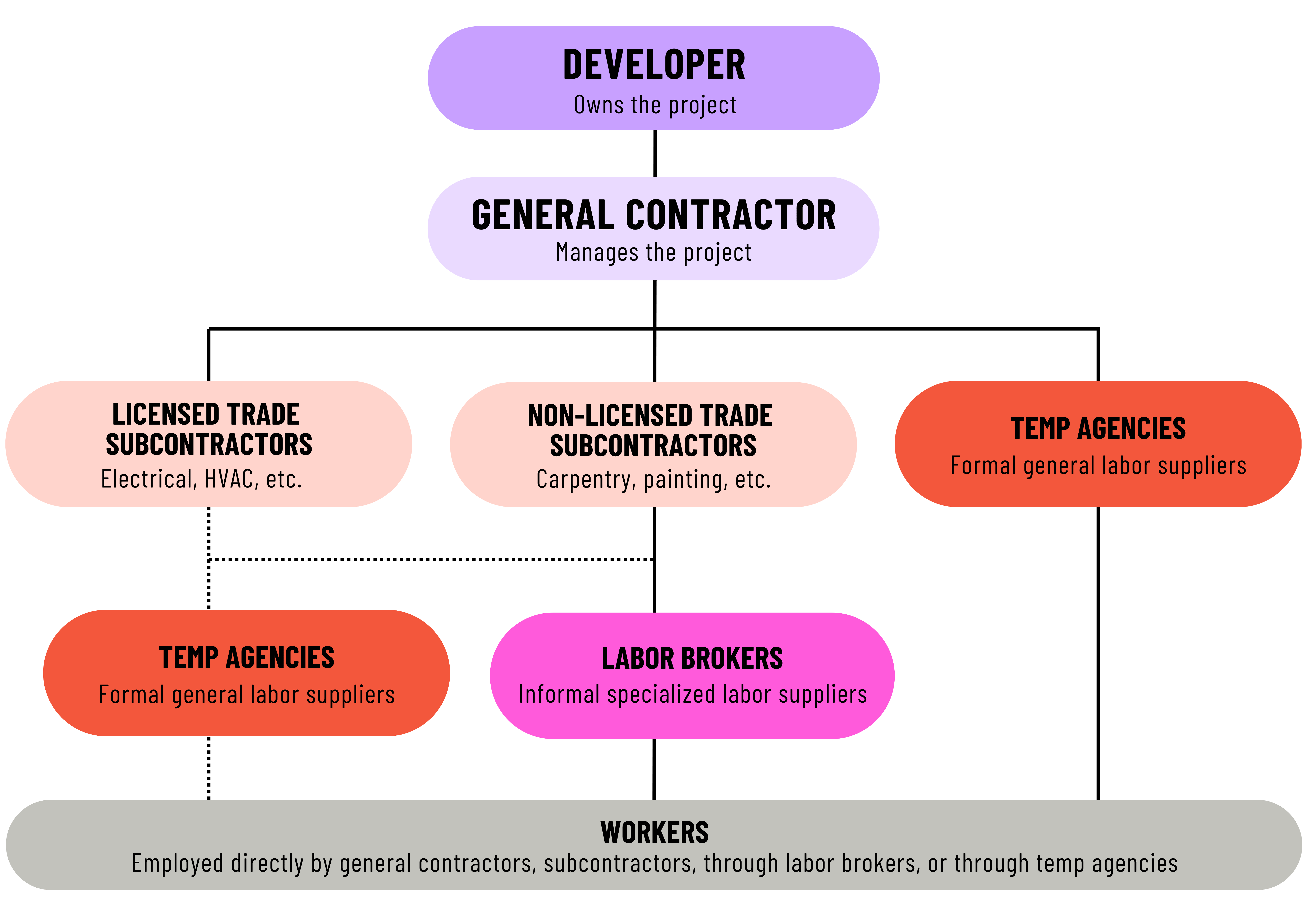
Figure 1 — How the Work Is Organized. A developer controls the project and a general contractor (GC) manages it, while the workers building it are employed through multiple layers. Most temp agencies are contracted directly by GCs, although subcontractors in both licensed and non-licensed trades also use them for general labor and prep work. Dashed lines indicate these less common relationships.
Across Miami-Dade, Broward, and Palm Beach counties, we identified 107 major commercial construction projects currently underway, worth roughly $25.3 billion. Most are luxury apartment towers, with mixed-use developments, institutional buildings, and affordable housing making up the rest. Miami-Dade accounts for 59 of those projects at about $12 billion of the value: roughly 55% of the region’s projects and 47% of the total construction value.
Let’s trace this market in the same way as Figure 1, from the top-down.
The 107 projects we identified are associated with 96 different developers. Counted by corporate name, the top of the market looks extraordinarily fragmented. But counting a $37 million warehouse and a $1 billion tower as equivalent conceals the industry’s economics.
When measured in dollars, the picture changes. According to our analysis, the top three developers are responsible for 39% of total construction value, the top five for 48%, and the top ten for 63%.
One major Miami developer pointed to financing and zoning as explanations for that concentration. A community bank might finance a small developer building 10 or 15 apartments on half a block. But zoning restrictions on small apartment complexes and the difficulty of obtaining approvals across different municipalities favor corporations that are able to navigate the demands of larger projects. Those projects depend on private credit funds and institutional lenders, which tend to make massive loans to developers with whom they have pre-existing relationships.
Project value is not the same as employment: an expensive tower doesn’t necessarily contain a proportionate share of the region’s worker-hours. But it does show where capital is concentrated, which corporations have the largest pipelines and financial exposure, and which projects matter most to the institutions financing Miami’s growth.
* * *
Below the developers, the market narrows again. The developers in our analysis hire from a pool of 31 GCs. Just four oversee about half the mapped projects, representing 64% of construction value.
The practical pool is smaller still because GCs tend to have a specialization. One of the leading GCs builds almost nothing but market-rate apartment towers. Another builds primarily institutional projects. Another specializes in hotels and hospitality. A developer putting up a condominium tower is choosing among only a handful of GCs that work at that scale and in that project type, not the total pool of 31 firms.
Nor does it appear that developers simply award projects to the lowest bidder. They develop relationships that persist across projects for years, which heavily influences project awards. One developer has used the same GC on 18 of its last 19 South Florida projects going back to 2015, and that developer accounts for nearly half of that GC’s regional portfolio. Another sends more than half its regional work to a single GC.
* * *
In order to carry out the work, GCs typically engage temp agencies, which largely supply general labor, and trade-specific subcontractors (“subs”) responsible for work such as pouring concrete, framing walls, running electrical systems, installing elevators, setting exterior glass, and putting on roofs.
Subs can be broadly grouped into two categories: those operating in more regulated trades, such as electrical work, HVAC, and elevator installation, and those operating in trades where individual workers generally don’t need occupational licenses, such as carpentry, drywall, and painting. In more regulated trades, subs are more likely to hire their trade workers directly, although we have observed them using temp agencies for general labor and preparation work. In less-regulated trades, subs tend to rely on labor brokers to recruit and pay crews, while also using temp agencies to supplement their workforces. According to investigations, labor brokers commonly engage in misclassification, wage theft, payroll-tax evasion, and workers’ compensation fraud. These accounts have been substantiated by our own findings.
Each of these hiring channels are racialized. Temp workers are predominantly Black, both immigrant and U.S.-born. Workers hired directly by subcontractors and those recruited through labor brokers are predominantly non-Black Latine. Those recruited through labor brokers, however, are especially likely to lack work authorization.
Just as developers repeatedly hire the same GCs, GCs often return to the same temp agencies and subs across multiple projects. These vendors appear to form relatively concentrated, recurring markets of their own. Five temp agencies accounted for 94% of the temp assignments we identified, and one appeared on two-thirds of the projects we mapped, while the same subcontractors repeatedly appear across projects managed by different GCs and owned by different developers.
Workers also recur within these relationships. Our organizers began seeing the same people at different projects after only a month of canvassing worksites. About 65% of the temp workers we interviewed had been reporting to the same agency for more than a year. One person had been dispatched through the same agency to projects run by the same GC for nine years.
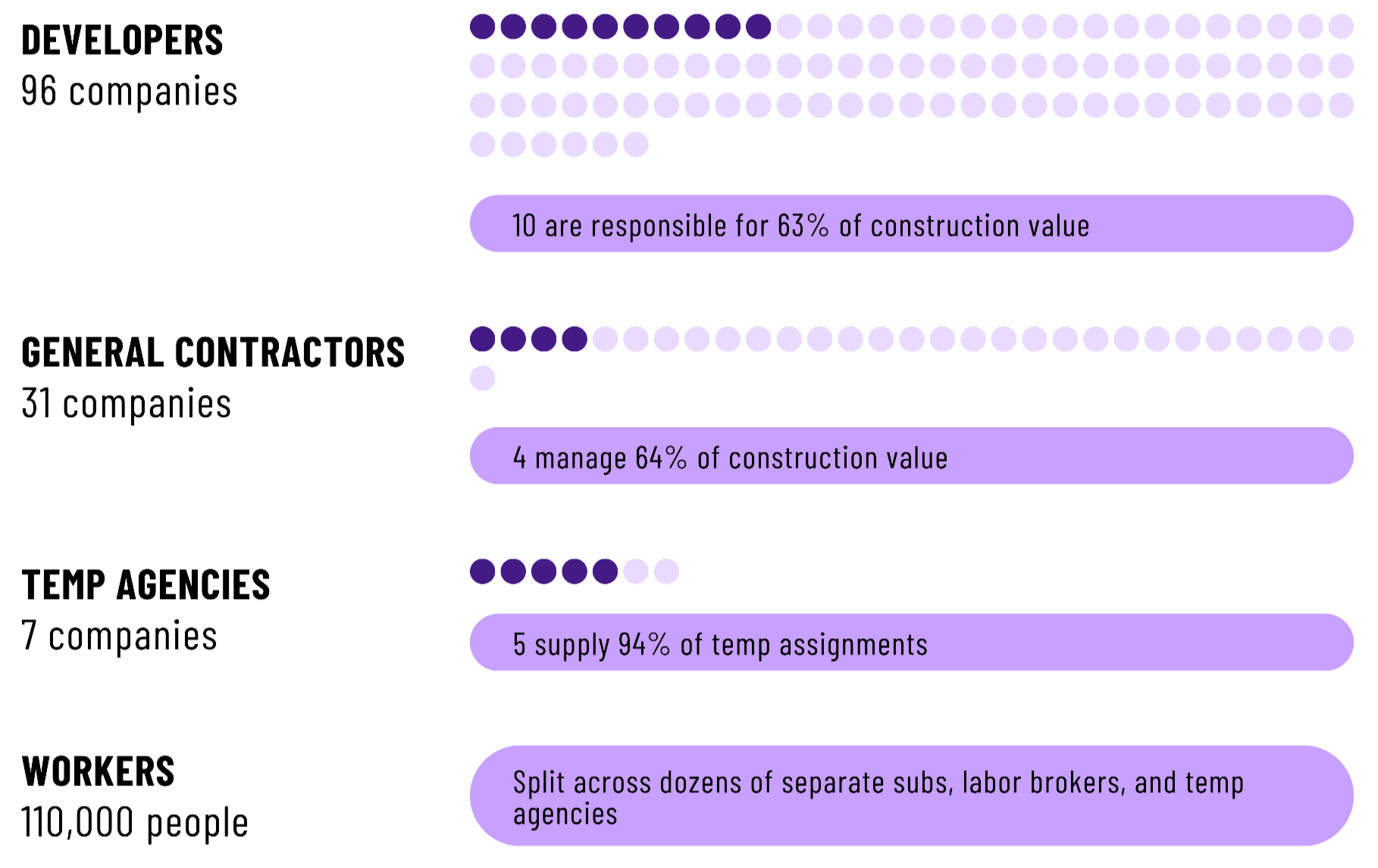
Figure 2 — How the Market Concentrates. Across 107 major South Florida projects, a small number of developers, GCs, and temp agencies account for a disproportionate share of construction value and temp assignments.
The highly concentrated GC market ultimately means that decisions made by a small number of companies shape the market in which many employers compete. Standards such as wage floors, benefits, training and safety requirements, fair-chance hiring, and protections for organizing can therefore travel through a much larger network of employers when introduced at this point of concentration. Those recurring relationships also create places where workers can build organizations that persist from one project to the next.
The question, then, is where in this network to begin organizing.
A Strategy for Organizing the Industry
In a nonunion construction market, workers who want to organize face a Catch-22. If they organize their employer and win a union contract, their employer’s labor costs rise while competitors remain free to bid at lower standards. Workers can win higher wages only to lose the jobs that would pay them.
For example, suppose workers at a concrete subcontractor organize and win wages and benefits worth an additional $12 an hour. The subcontractor must either absorb that cost, eating into their already thin profit-margin, or incorporate it into future bids while its competitors continue bidding at the old rate. Price isn’t the only consideration in construction awards, of course. Relationships and reliability matter too. But if a GC can obtain comparable work more cheaply elsewhere, the union subcontractor is at a competitive disadvantage.
As long as GCs can redirect work to employers operating at lower standards, workers’ gains remain vulnerable. So while employer-level bargaining is necessary, it can’t be the outer boundary of an organizing strategy.
Mark Erlich describes taking a “whole- submarket approach” as an alternative: organize enough competing employers within a defined trade, building type, and region that their clients cannot readily avoid the new standard. Construction unions’ “area master agreements” reflect this principle by establishing common terms among signatory employers.
The challenge in a predominantly nonunion market is building enough coverage for those terms to impact the economics of the industry. An area master agreement with only a handful of signatories provides little protection against being undercut if clients can easily take their business to nonunion competitors.
Commercial cleaning offers a useful comparison. In the Justice for Janitors campaigns, SEIU combined pressure on building owners—the buyers of cleaning services—with organizing workers at the cleaning contractors competing for their business. It also used conditional, or “trigger,” agreements to address the risk of signing first: specified terms would take effect once employers representing an agreed share of the market had signed, reducing the danger for one contractor to increase its labor costs ahead of its competitors.
Commercial construction and commercial cleaning differ in important ways. For example, buildings need ongoing janitorial services, while construction work ends when a project is complete. The lesson isn’t that the same agreement can simply be transplanted from one industry to another. It’s that changing what buyers require while organizing the suppliers competing for their business can change the economics of the market, making better working conditions a requirement for winning work rather than a competitive disadvantage.
Our market analysis suggests applying that principle through three connected forms of intervention: vertically, by establishing labor standards on projects sought by the GCs that use temp agencies; horizontally, by extending those standards across competing temp agencies; and from the bottom-up, by building a worker organization capable of winning and enforcing those standards. Each addresses a different way that employers can otherwise evade workers’ gains.
Project Labor Standards (Vertical)
For temp agencies, the most valuable relationship is with the GC, not the developer. Agencies frequently work under master agreements that extend across a GC’s projects, making the relationship a continuing source of business. But the developer controls each project’s money and can condition access to that money on compliance with labor standards.
Those standards could be established through a “community benefits agreement”, “responsible contractor” policy, or other binding project requirement. The particular vehicle matters less here than the mechanism: the developer requires its GC to meet specified standards, and the GC incorporates those obligations into its contracts with subcontractors and temp agencies. Requirements could include targeted hiring and apprenticeship pathways for workers with criminal records; fair-chance hiring protections; wage floors; training and safety standards; protections for organizing; accommodations for workers navigating probation and other forms of state supervision; and independent monitoring to ensure compliance.
If a campaign was successful in pressuring a developer to adopt project labor standards, it could affect the temp agencies contracted for the project. Because meeting the standards becomes a condition of continuing to receive work, the agency has a financial reason to comply.
The project budget and contractor payments would have to account for the cost of compliance—including the rates GCs would pay temp agencies—so that higher wages and benefits are funded through the contracting chain rather than simply imposed on temp agencies whose margins may be too thin to absorb them.
The strongest targets would therefore be developers with significant market share, recurring projects, recurring relationships with GCs that contract with temp agencies, and points of vulnerability that a strategic campaign can reach. One project agreement wouldn’t change the market. But an agreement covering work managed by a strategically chosen GC could establish a standard that workers then fight to extend across the GC’s other projects and the temp agencies competing for its business.
Trigger Agreements (Horizontal)
Project standards address one part of the Catch-22 by making better conditions a requirement for receiving valuable work on a particular project. Horizontal organizing addresses another part. It’s project-agnostic, intended to prevent GCs from shifting work to other temp agencies competing on the basis of lower labor costs.
One mechanism is a series of trigger agreements negotiated temp agency by temp agency, with economic terms that activate once signatories represent an agreed share of the relevant market. Workers could therefore win commitments sequentially without leaving the first agency exposed to competitors operating at lower labor costs. The appropriate threshold depends on how much of the relevant labor supply the signatory agencies control and how easily GCs could replace them, rather than on the number of agencies that sign.
Enforcement of wage, safety, tax, and employment laws through filing cases in court and government agencies, referred to as “strategic enforcement,” complements this strategy by attacking illegal forms of cost-cutting throughout the contracting chain. A temp agency shouldn’t be able to underbid compliant agencies by shaving hours or making unlawful deductions, and a subcontractor shouldn’t be able to lower its labor costs by misclassifying workers or sourcing them through labor brokers that evade payroll taxes, wage requirements, or safety obligations. Strategic enforcement at each layer can therefore make collectively negotiated standards easier to sustain.
Vertical project standards and horizontal trigger agreements work together. The first creates demand for better labor practices; the second makes that labor increasingly difficult to obtain outside the new standard. As coverage expands, switching contracts becomes a less effective means for GCs to avoid workers’ demands.
Neither mechanism, however, creates the worker organization capable of winning those commitments, expanding their coverage, or enforcing them when they are violated by temp agencies.
Worker Organization (Bottom-Up)
For temp workers, that organization should be anchored at the point of dispatch: the temp agencies that employ them. A union established at this point can connect workers who are otherwise scattered across job-sites and GCs, creating membership and relationships capable of surviving reassignment.
Worker committees inside agencies could recruit coworkers, develop demands around dispatch, pay, fees, and safety, and build toward the majority support necessary to win union recognition and collective bargaining rights. Premajority organizing can begin that process before a majority exists, allowing workers to develop leaders, infrastructure, and a shared program while the broader market strategy changes the incentives facing their employers.
Worker organization, however, cannot rely primarily on workers withholding their labor. Federal labor law protects many forms of collective action over working conditions, and a temp agency can’t lawfully deny workers future assignments in retaliation for protected activity. But daily dispatch makes that protection difficult to enforce. Agencies constantly move workers between projects and offer no guarantee of work the next day. If workers refuse an assignment or walk off a job, the agency can dispatch other workers immediately and later portray the original workers’ disappearance from the rolls as an ordinary fluctuation in demand. The structure of temp work makes retaliation difficult to identify and prove.
Worker organizing therefore has to be paired with a broader strategy that addresses the other forces shaping temp agencies’ decisions.
The risks for temp workers organizing are substantial and cannot be understated. Many temp workers we spoke with—including first- and second-generation immigrants who were citizens or lawful permanent residents—described being terrified of ICE.
Additionally, our research suggests that about 75% of temp workers in construction may have criminal records: half the temp workers we interviewed reported having a record, while another quarter declined to answer. Our organizers also encountered workers who said they had no record, but simultaneously reported being on probation, living in halfway houses, or wearing GPS monitors.
In these circumstances, losing an assignment can threaten income, compliance with supervision requirements, and ICE detention and/or deportation; all while dispatch favoritism can foster competition rather than solidarity among workers. The state’s coercive power has become a primary source of employers’ leverage over workers. Organizing in this context requires understanding how criminal supervision and immigration enforcement shape workers’ lives, providing support to navigate those systems, and building the trust among English-, Spanish-, and Kreyòl-speaking workers on which collective action depends.
Recruiting temp workers into existing union jobs—a practice known as “stripping”—can complement this effort. But temp agencies can readily replace workers who leave: dozens of people show up every morning hoping for assignments. Recruitment alone therefore leaves the underlying labor market intact.
A temp worker union would provide the organization necessary to define workers’ demands, bargain with their employers, and enforce what they win.
Building Labor Partnerships
Executing this strategy requires different organizations with distinct roles, capacities, and legal relationships to the workers and companies involved.
Existing building-trades unions bring relationships with developers, GCs, and subcontractors; knowledge of construction agreements; bargaining expertise; research capacity; resources to hire organizers; political relationships; and sophisticated apprenticeship programs with the capacity to develop worker leadership at scale. Those resources could be particularly important to winning individual project standards, expanding those standards across projects, and creating pathways from temp work into registered apprenticeships and union trades.
A temp-worker union has a different role. Organized by temp workers themselves, it can build membership and leadership within and across temp agencies, seek majority support and recognition, bargain directly with temp agencies, negotiate trigger agreements, and enforce the agreements workers win. Its focus is the employment relationship between temp workers and the agencies that employ them.
A worker center plays a third role. It can build relationships with nonunion workers, investigate conditions across agencies and jobsites, research the financial and contracting relationships that shape the industry, pursue legal and regulatory enforcement against actors engaging in illegal practices, mobilize community allies, and campaign for higher standards from developers, GCs, and other actors throughout the contracting chain.
Just as importantly, a worker center rooted in this base brings experiential knowledge of organizing workers navigating criminal supervision, immigration enforcement, reentry, and trauma—and an understanding of how those conditions shape workers’ choices, the risks they may be willing to take, and the support they need to participate and lead.
Together, these organizations could bring more construction work under union contracts, open pathways for workers with criminal records from temp jobs into higher-paid trades, and improve conditions for those who remain in temp work.
* * *
As Parts I and II discussed, building-trades unions once turned a project-based industry into some of the highest-paid blue-collar careers in the country. In nonunion markets, the challenge now is to recover what made those institutions powerful while extending their protections to the workers that were left outside it.
Taken together, the strategies discussed in Part III offer a way to organize both the workers and the work without reproducing the exclusions on which labor power in the trades once depended.
A closing note: What we’ve laid out here is informed by our experience organizing formerly incarcerated workers, alongside conversations with formerly incarcerated leaders and labor organizers across trades and industries.
We’re always learning, and this piece is a snapshot of our thinking at this particular moment in time. If a fact, framing, or omission doesn’t sit right with you—or your experience points in another direction—tell us. We really do welcome conversation, corrections, additions, and pushback.
We now turn to an image in Elizabeth Catlett’s series, “My role has been important in organizing the unorganized.”
Elizabeth Catlett, My role has been important in organizing the unorganized (1947)
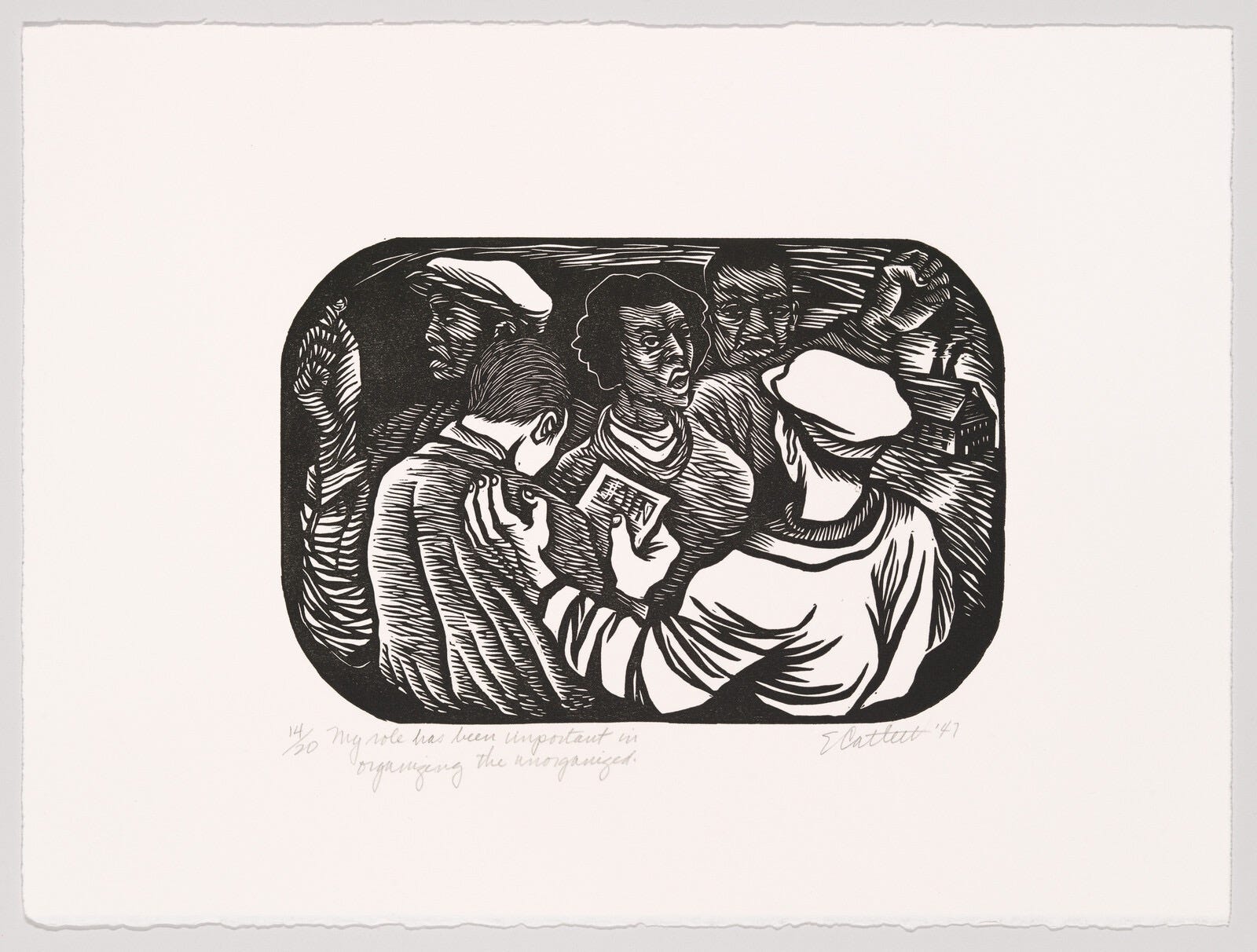
Elizabeth Catlett, My role has been important in organizing the unorganized, 1947, printed 1989. Linoleum cut. From The Negro Woman series, 1946–47 (re-titled The Black Woman in 1989). © Catlett Mora Family Trust / Licensed by VAGA at Artists Rights Society (ARS), New York. Source: Whitney Museum of American Art.
Catlett created this print as part of a fifteen-image series centering the labor, struggle, and lives of Black women. Here, a Black woman organizer stands among four workers gathered closely around organizing material. One reads a leaflet while the others lean in.
Catlett offers a concise answer to the question at the center of this series: How do we rebuild our power? Organize the unorganized!
And finally, here’s what we’re reading this month.
What We’re Reading
Derek R. Trumbo, One Bite at a Time: Writing Reentry (Prison, 2026).
Reflecting on his experience coming home after nearly 20 years in prison, Trumbo’s essay captures the complexity of reentry. Release isn’t a clean break from punishment and freedom isn’t a tidy redemption story. Reentry is the slow, unfinished process of relearning choice, trust, love, home, and accountability while your body still expects abuse.
Trumbo refuses both pity and triumphalism. He writes from within the setbacks, breakthroughs, and contradictions of rebuilding a life after prison and, in doing so, insists on the full humanity of people returning home.
If our work resonates with you, here are ways to take action with us.
Take Action
Fuel the Work → Donate now
Learn More → beyondthebars.org
Stay Updated → @beyondbars_mia
Take Action → Sign up to volunteer